A key principle in understanding Austrian economics is seeing the inefficiency of government spending. In an era of overbearing states and reckless fiscal policy, this principle must be emphasized repeatedly. Politicians might claim the best of intentions when dishing out funds for military defense, social welfare, and public works. Their civil servants might try to realize these plans efficiently and thriftily.
However, the very nature of government spending goes against sound economics because government does not subject itself to the rigors of the free market. The latter operates according to a system of profit and loss, which enables entrepreneurs to use market prices as a guide to invest their limited capital rationally. Those who do this satisfy their consumers and earn a profit; those who do not suffer losses that force them to overhaul their business model or close down.
Governments escape this efficiency test because of their ability to draw money from taxes, a seemingly bottomless well of capital. Knowing that they can always fall back on tariffs and the taxpayer, politicians are liable to mandate outlandish policies that bureaucrats carry out with appalling wastefulness. As the great economist Murray N. Rothbard notes, this phenomenon makes inefficiency “inherent in all government enterprise” (emphasis in original).
Among the starkest examples of government inefficiency in modern times is Joseph R. “Joey” Smallwood’s premiership of the Canadian province of Newfoundland (now officially known as Newfoundland and Labrador). Premier from 1949 to 1972, Smallwood was the most consequential statesman Newfoundland has ever produced, having been the driving force behind its joining Canada in 1949. A considerable influence in federal and provincial politics, he also built a substantial international reputation.
Smallwood’s chief goal was to modernize Newfoundland. The province was heavily reliant on its fisheries, whose outports often used antiquated technology and whose saltfish export trade was bringing in poor returns. Chronic unemployment had stalked Newfoundland for years. Most fishermen struggled to make ends meet, and there were few alternative means of employment. Ambitious young people, seeking a better life, were emigrating in droves.
Smallwood sought to overcome these difficulties through audacious government programs. The Canadian federal government had given the new province a cash surplus of approximately $45 million. Proclaiming that Newfoundland must “develop or perish,” Smallwood invested this money in new industries. In the 1950s, over a dozen manufacturing plants were established in Newfoundland, some built directly by the government and others having received loans.
At first, it all seemed quite promising. But as the commentator Harold Horwood remarks, Smallwood was ill versed in mathematics and had previously failed as a small businessman. He was therefore reckless with his finances even by the standards of government leaders.
As the Newfoundland and Labrador Heritage Website notes, some of Smallwood’s manufacturing plants relied on expensive imported raw materials, which virtually doomed them to economic loss. Even those that utilized local materials frequently struggled to find a secure market for their products since the province’s market was rather small and the Canadian and international markets were extremely competitive. Despite handsome government support, many of the industries folded quickly, taking with them much of Newfoundland’s cash surplus. Those that survived could provide employment only for a select few.
If a commercial company wished to stay in business after such setbacks, it would urgently have to rethink its commercial strategy. But Smallwood’s government could rely on taxpayer money for assistance. Thus, he continued to endorse poorly conceived development projects. In the late 1960s, for example, Smallwood supported the building of an oil refinery at Come By Chance. The result, the Heritage Website notes, was an economic disaster.
Although he cannot be blamed for the international 1973 oil crisis, the fact that there were already refineries in eastern Canada by this time prevented the Newfoundland refinery from becoming the economic miracle that Smallwood expected. It closed in 1976, having run up around $500 million in debt.
Another example is Smallwood’s establishment of a paper mill in Newfoundland. Because the island already boasted two paper mills, it was decided to base this third one on the mainland in Labrador. Labrador had the requisite forests, but as the Heritage Website points out, its territory was underdeveloped and key waterways were frozen for much of the year. These factors, which any half-decent entrepreneur would have spotted, made its construction ridiculously expensive—approximately $155 million. As one might expect, the venture proved to be economically unsustainable.
Smallwood’s modernization of the fisheries was also dogged with incompetence. For instance, in December 1949, Smallwood was conned by Icelandic fishermen (or men pretending to be Icelanders) who promised to breathe new life into Newfoundland’s fisheries if the government gave them money to purchase some modern herring boats.
Without properly checking their identities, Smallwood enthusiastically gave them a sizable $412,000. The Icelanders (or pretenders) acquired some obviously old vessels, caught a few token fish, and then disappeared—taking the government’s money with them. Smallwood never got these funds back. Indeed, as Smallwood’s biographer states, he lost even more money trying to recuperate part of his loss by selling the old boats. They remained unsold for three years until “a buyer . . . paid $55,000 for them—a sum he was able to afford by way of a government loan.”
Much more could be said about the failed policies of Smallwood’s government. Nevertheless, the evidence already provided illustrates well enough the incisiveness of the Austrian critique of government spending. Smallwood had good intentions, but as a government leader directed by political goals, he pursued projects recklessly and inefficiently. When they failed, he simply moved on, knowing that greater taxes could be levied to cover the debts.
Supporters of Austrian economics have protested the fallaciousness and injustice of this behavior for years. The fact that governments around the globe continue to act like this makes it imperative to continue such protests.
People say government is corrupt. If it were corrupt, it would be acting in ways contrary and detrimental to its purpose, and it would be possible to right the course. In truth, government acts in ways that befit its nature.
Today’s governments are states ruling by legal coercion. There is another, unacknowledged “government” that works to govern our behavior peacefully, and it’s usually called the free market. But to states, the market—whether free or otherwise—is the farm from which they extract wealth and distribute it according to their perceived needs. States are plundering gangs that wouldn’t exist without something to plunder—a market. But can markets exist without states?
We might never know. States will not step aside—the setup is far too rewarding for those in charge. So, we watch as government runs off the rails in its drunken pursuit of power.
Given this arrangement, how is it possible states can maintain their grip on the minds of its captives? From the perspective of those under its thumb, it is an elaborate, interwoven mix of claims accepted as truths.
Let’s touch on a few.
Captives view everything government does as the fruits of democracy, as if the world around them came into being by free choice at the polls. Democracy is how people believe they maintain their freedom. It’s their check on state power.
The state watches as some of its captives shoot and rob each other and propose that it’s only right to make it difficult for everyone to acquire guns. The thugs cheer and the crime rate goes up. States feel uncomfortable with their captives owning guns.
Some captives try to stick the Bill of Rights in government’s face. The Bill of Rights is a tourist attraction. Who sweats a document sequestered in the National Archives? Even so, who interprets and enforces the Bill of Rights? Elected stiffs from Woodrow Wilson onward, as well as a few appointed ones, have been telling them the Constitution is alive. In other words, their rights are dead.
Some captives still refer to government officials as their servants. How many politicians have the demeanor of servants? Politicians respect money and votes. Since most voters aren’t organized, it’s the politicians’ rich supporters who help pull the levers of power.
Captives believe it’s only logical that the state should have complete control of the military, police, and courts. What saints do they know personally who could be trusted with such power? And how will the state fund these various functions? Through voluntary trade on the market? Why should it mess with production and exchange when all it has to do is nudge them with a gun? The state is a monopoly of crime, a fact too shameful for them to admit.
Almost all captives complain about high taxes. But the state posts signs to assuage their grief: “Your tax dollars at work.” And it points to the military and its global presence, stirring patriotic fervor. Thus, some captives console themselves with what taxes provide, failing as always to look at the alternatives.
If they’d had better schooling, they might know something about Randolph Bourne, who in 1918 wrote the following:
The modern State is not the rational and intelligent product of modern men desiring to live harmoniously together with security of life, property, and opinion. It is not an organization which has been devised as pragmatic means to a desired social end. All the idealism with which we have been instructed to endow the State is the fruit of our retrospective imaginations. What it does for us in the way of security and benefit of life, it does incidentally as a by-product and development of its original functions.
But the captives, some of them, still have hope for freedom under state rule. They revive the memory of the Gipper, Ronald Reagan, their sole purported savior in recent history, who promised to get government off their backs. He pledged to abolish the departments of energy and education. Somehow it didn’t happen.
And rather than ditch the bankrupt Ponzi scheme called social security, he followed Alan Greenspan’s advice and increased taxes to postpone the bankruptcy. During the Gipper’s eight-year reign, the federal debt almost doubled and civil liberties diminished. Oh, those aching backs.
But wait—many captives point to Abraham Lincoln as a freedom fighter.
Let’s see. No Union lives were lost during the Confederacy’s thirty-six-hour shelling of Fort Sumter, an incident provoked by Lincoln’s ordering the fort reprovisioned instead of abandoned. A month earlier, he had ignored a Confederate peace commission that had traveled to Washington, DC, to negotiate a peaceful secession. But Lincoln had his ‘incident,’ got his war, and some eight hundred thousand people died, including civilians and slaves.
The end of slavery was never Lincoln’s objective, as he repeatedly stated, but rather one of the byproducts Bourne refers to. By 1840, the British Empire had ended slavery peacefully through compensated emancipation. During the nineteenth century, many other countries ended slavery without war. If manumission was Lincoln’s goal, why did the master statesman need a long, bloody war to achieve it?
Lincoln invaded the South to regain lost tariff revenue when the southern states seceded. Lincoln, in other words, murdered and imprisoned people to carry on his policy of predation, also known as Union mercantilism.
Moving ahead a half century, President Woodrow Wilson imposed a maximum twenty-year prison sentence for anyone criticizing the government during World War I. “Civil liberties” were synonymous with treason. “Make the world safe for democracy”? Why not “Make the world safe for freedom”? Why did Wilson ship a million conscripts packed like sardines overseas to join a war that had already killed five million men?
World War II was different—the so-called good war, even if it was the costliest conflict in human history. Civilian deaths outnumbered military deaths by over sixteen million, and total deaths on both sides exceeded seventy-two million. The good war saw the guys in white hats set the precedent for dropping nuclear weapons on mostly civilian populations. Who was being defended when we incinerated two hundred thousand people whose leaders had earlier asked to negotiate a conditional surrender, a condition we ultimately agreed to?
Was the state defending its citizens during the buildup to war when Franklin D. Roosevelt neglected to tell Pearl Harbor commanders Short and Kimmel an attack was imminent? Twenty-four hundred troops lost their lives in that attack to join a war the president promised we would never join. The man who made the promise had an eight-point provocation plan to get Japan to attack the US.
Did the war in Vietnam stop communism in its tracks and keep other dominoes from falling? The only thing it stopped were the lives of 58,209 American soldiers and several million Vietnamese civilians. And these figures don’t include countless others who suffered and perished from Agent Orange exposure.
Were trillions of dollars in taxes at work on September 11, 2001, defending Americans from terrorist hijackers? And did they get their money’s worth later when the president invaded a country posing no threat to their security and having no connection to the attacks?
They grumble about inflation and never mention its role in the state’s growth and wars. They come out of college believing the Federal Reserve is our top inflation fighter. Ironically, it’s true but only because the Fed is the sole source of inflation. It’s a little like saying Al Capone was Chicago’s top crime fighter. To lower the incidence of crime, all Capone had to do was let up on it.
So, there you have it—the state in a nutshell. It is systematically antifreedom but poses as its defender. And the captives buy it. The only way the captives can eliminate their overlords is with ideology, but the state has the majority of ideologists, both left and right, on its side. They’ll have to educate themselves and enough others to pose a threat, which they’ve been trying since 1576 if not earlier.
You would think freedom would be an easy sell, but it isn’t. We keep trying because we can’t live without it.
The provision of private healthcare in Canada is contingent on the ability of private actors to satisfy all of the conditions embedded within government legislation. However, the severity of these conditions means that most aspects of private healthcare are essentially outlawed, as they have been for many decades.
Perhaps that wouldn’t matter if the government kept the promise it made to Canadians when it arbitrarily imposed universal healthcare (Medicare) on the country. The government promised “to make sure that people could get care when it was needed without regard to other considerations” (emphasis added).
The government breaks this promise on a daily basis. Currently, there are approximately 1.2 million Canadians stuck on a government waiting list for healthcare that they need. This is a death sentence for many of them, as it has been for thousands of patients who have gone before them.
Politicians are Guilty of Criminal Acts
When the failure of Medicare became undeniable many decades ago, the government should have repealed the legislation because it was obvious that they could never keep their promise. However, they didn’t repeal the legislation. They continued the charade. The federal government still insists that its primary objective is “to protect, promote and restore the physical and mental well-being of residents of Canada and to facilitate reasonable access to health services without financial or other barriers” (emphasis added).
Patients who endure considerable suffering as they languish on a waiting list – where many of them die – cannot be seen to have been given reasonable access to health services in the government’s Medicare system. The government also prevents them from having reasonable access to a private healthcare option.
Thus, reasonable access is an obvious deception, with benefits flowing to highly paid, power-hungry politicians, bureaucrats, and administrators wanting to maintain control over massive, inefficient healthcare bureaucracies at the federal and provincial levels. This deceitful behavior fits the definition of fraud, and should be prosecuted as such.
Thousands of Canadians die while they wait for the care that the government promised to deliver when they need it. That’s bad enough, but due to the prohibition of private healthcare, politicians have prevented these patients from saving their own lives, and that’s a criminal offence! Section 262 of the Criminal Code reads:
262 Every person is guilty of an indictable offence and liable to imprisonment for a term of not more than 10 years or is guilty of an offence punishable on summary conviction who
(a) prevents or impedes or attempts to prevent or impede any person who is attempting to save his own life, or
(b) without reasonable cause prevents or impedes or attempts to prevent or impede any person who is attempting to save the life of another person.
Section 262 (a) should apply when a patient is prevented from saving their own life because private healthcare is forbidden.
Section 262 (b) should apply when a private doctor is prevented from saving the life of another person because private healthcare is forbidden.
All politicians, past and present, who have supported Medicare legislation should be prosecuted for fraud. Likewise, those who have supported the suppression of private healthcare should be prosecuted under section 262. In both cases, politicians should also be subject to civil action. Unfortunately, none of this will happen because, in a democracy, politicians are not governed by the same laws as the rest of the population.
Politicians are Legally Untouchable
If politicians were personally accountable for the damage they cause, guess what? They wouldn’t cause any damage! However, we cannot hold them personally accountable because equality under the law does not exist in a democracy.
In the private sector, you are accountable for your actions. If you break your neighbour’s window, you pay for the replacement. If you are a politician, and you break the window in the course of performing your official duties, you can charge the cost of the new window to taxpayers. Moreover, in a democracy, taxpayers have no control over political actions, as two American professors have warned us:
The central point that emerges from our research is that economic elites and organized groups representing business interests have substantial independent impacts on U.S. government policy, while mass-based interest groups and average citizens have little or no independent influence. . . . The chief predictions of pure theories of Majoritarian Electoral Democracy can be decisively rejected. Not only do ordinary citizens not have uniquely substantial power over policy decisions; they have little or no independent influence on policy at all.
Politicians say that society can grow and prosper only if politicians make laws to grant themselves legal immunity for actions they undertake in the performance of their public duties. So, that’s what they do, and that’s what most people do not understand. The lack of accountability is a symptom of democracy. It encourages bad decisions within the political class. It encourages inefficiency, as we see with the ongoing deterioration of Medicare.
When citizens demand better service, politicians respond by saying “Okay, but that means we have to take more of your money.” So taxes are raised, more bureaucrats and administrators are hired, and the inefficient Medicare bureaucracies that politicians and bureaucrats regard as their personal fiefdoms, grow ever larger. That’s why healthcare is the single largest item in many provincial budgets. As Bruce L. Benson wrote:
The fact that government law has taken over as much as it has is not a reflection of the superior efficiency of representative government in making or enforcing law that facilitates interaction. It is, rather, a reflection of government’s general purpose of transferring wealth to those with political power.
The expressed aim of government officials in a representative democracy may not be the accumulation and centralization of power, but that is a necessary consequence of the process as it has evolved within the institutions developed by medieval kings. Whether the government producing law is a totalitarian king or a representative democracy, power is centralized and coercion is used to impose rules beneficial to some upon the rest of the population. Government is still a wealth transfer mechanism.
The legacy media parrots the government’s healthcare mantra that demonizes private firms seeking to profit through the provision of healthcare. However, the same media remains silent about politicians, bureaucrats, and administrators who have profited greatly from monopolizing an industry that allows them to determine their own salaries, and which results in lengthy wait lists, thousands of preventable deaths, a surplus of highly paid bureaucrats and administrators, and a dearth of the stuff that actually matters, such as doctors, nurses, hospital rooms, medical equipment, life-saving medicines, etc.
This government/media propaganda is becoming less effective due to the ongoing collapse of Medicare. A majority of Canadians polled are now in favor of private healthcare for those who are able to afford it. If and when that happens, Canadians will discover the superiority of private healthcare, where full accountability makes it far more efficient and cost effective, and much less lethal, compared to the government’s Medicare scam which was gifted to Canadians under the guise of democracy.
Never is a very, very long time in politics. Yet whenever the topic of secession or so-called national divorce comes up, how often do we hear that “secession will never happen.” It’s difficult to tell if people using the term “never” actually mean it. If they mean “not in the next ten or twenty years,” that’s plausible. But if they truly mean “not in the next 100 (or more) years,” it’s clear they’re working on the level of absolutely pure, unfounded speculation. Such statements reflect little more than personal hopes and dreams.
Experience is clear that the state of most polities often changes enormously in the span of a few decades. Imagine Russia in 1900 versus Russia in 1920. Or perhaps China in 1930 versus China in 1950. If someone had told the Austrian emperor in 1850 that his empire would be completely dismembered by 1919, he probably would have refused to believe it. Few British subjects in 1945 expected the empire to be all but gone by 1970. In the 1970s, the long-term survival of the Soviet Union appeared to be a fait accompli. For a visual sense of this, simply compare world maps from 1900 and 1950. In less than the span of a human lifetime, the political map of the world often changes so as to be unrecognizable.
Yet there are always those who are quite comfortable with the status quo and who tell themselves it will continue indefinitely. Many find comfort in the hope that their favorite national regime will be a thousand-year reich, living on indefinitely into the rosy future of “progress.” Claims to political immortality are also frequently important as rallying cries in support of the state. As French Marxist philosopher Régis Debray noted, the idea that “France is eternal” may be empirically untrue, but the sentiment nonetheless serves to motivate the French soldier or French nationalist to preserve his regime.
Meanwhile, the opposite impulse, a recognition of the regime’s mortality is seen by many as a kind of heresy against the national political idols. It may be obviously true, but to say it out loud is “treason.” The cry of “traitor,” of course, has long been the go-to strategy for those with an emotional attachment to the regime. Like many heresies before it, this one must not go unpunished. Thus, “traitor” was the cry of the French republican who thought it better to butcher women and children in the Vendée rather than allow that portion of France to be independent. It was the cry of the Turkish imperialist who carried out a genocide against Armenian separatists.
The reality is that the current shape of any regime is more tenuous than many hope. The debate is not whether the US regime will fundamentally change in size and nature. The question is when and in what way. Those who are willing to examine the possibility of gradually unwinding state power peacefully through decentralization—rather than letting internal national conflicts explode into violence and revolution eventually—display a far better grasp of political history than the knee-jerk unionists.
The emotional nature of this opposition to secession can be seen in the fact that the opposition grants no middle ground in the debate. The only allowable options are the status quo or war.
Options for the “middle ground” include a confederation built on a consensus model in the style of the old Dutch Republic. There is the model of the very loose confederation in the style of the old Swiss confederation. There is the option of a customs union with voluntary membership, such as the European Union. There is the option of a mutual defense compact among independent polities, as we find in a multitude of defense leagues. None of these options require a state that imposes nationwide regulation and taxation in the manner of the enormous administrative state that we have today.
Yet most of those who oppose secession also oppose all of these options. We don’t hear, “Well, secession is too far, so let’s move toward a much more decentralized model.” Why do we never get this olive branch from the centralizers? Because their opposition to secession is more about supporting the status quo. They want a national government to impose nationwide policy in a way that reflects the national ruling class’s values. It’s the colonialist mindset all over again: “Oh, we can’t let those people in state X set their own rules for elections/abortion/trade. Those people are too unenlightened/racist/stupid to be allowed local autonomy.”
This intransigence can also be found in the way that the opposition often delights in the idea of using violence against potential separatists. Congressman Eric Swalwell, for instance, suggested the US government use nuclear weapons against internal separatists. And then there are those who make light of the idea of a second blood-soaked civil war. Indeed, the insistence on tying twenty-first-century decentralization to a war in the mid-nineteenth century (160 years ago) implies that the unionist “solution” back then justifies the same solution now. Note the emphasis is always on the American Civil War and not on the many examples of peaceful secession movements: Iceland from Denmark, Norway from Sweden, Singapore from Malaysia, Malta from the British Empire, and the Baltic states from the Soviet Union (to name a few). Instead, the average American antisecessionist is apparently obsessed with making war against his own neighbors.
Of course, that sort of thing can only be carried out today if modern Americans are willing to die and kill—or have their children die and kill—in the name of “preserving the union.” How many are willing to do this? Hopefully not many. Those who are willing to do it can only be described as fanatics.
The presence of these proviolence antisecessionists does remind us of the continued danger of political union, however. Those who favor union may interpret mere discussions of disunity as a sign of the need for ever-greater federal control over the population. This is also the strategy preferred by states: tendencies toward disunion are countered by an ever-stronger and ever-more-unyielding state. The strategy is tried and true. This is how a fragmenting Roman Empire was preserved for another 150 years after a breakup seemed all but assured during the third century. The emperor turned the empire into a military dictatorship. The same method of imposing unity has been employed countless times across countless polities—and at great cost to human rights and self-determination. Yet not even Diocletian’s dictatorship could ultimately prevent the secession of the western regions of the empire. (Justinian’s later attempts at reunifying Italy with the empire failed as well, and only brought enormous and unnecessary death and destruction.) Secession and disintegration have always been inevitable for large diverse states. The Romans were not immune. The Americans are not immune.
The answer lies not in doubling down on political unity, maintained through endless violence or threats of violence. Rather, the answer lies in peaceful separation through expanded self-determination, regional autonomy, confederation, and consensus. The choice we now face is between a rearguard attempt at preserving political unity “forever” and facing the inevitable reality. On one side, there are the unionists with their devotion to the status quo and their colonialist mindset. On the other side are those who seek to temper the power of the central state and pursue local self-determination. The centralizers are on the wrong side and will ultimately be on the losing side as well.
In his 1973 bookFor a New Liberty: The Libertarian Manifesto, Murray N. Rothbard characterized libertarians as the successors of the classical liberals of an earlier age.
“For the classical liberal movement,” Rothbard wrote, “was throughout the Western world, a mighty libertarian ‘revolution’ against what we might call the Old Order — the ancien régime which had dominated its subjects for centuries.”
The term “ancien régime” (French for “old regime”) usually refers specifically to pre-Revolutionary France. Rothbard aptly broadened the appellation to encompass the West more generally.
The Old Order
“This regime,” Rothbard continued, “had, in the early modern period beginning in the sixteenth century, imposed an absolute central State and a king ruling by divine right on top of an older, restrictive web of feudal land monopolies and urban guild controls and restrictions.”
The economic aspect of the Old Order, as Rothbard described it, was an unholy alliance between the State and its favorite producers: feudal landlords, guilds, and commercial monopolies. Thus, the Old Order was a witch’s brew of absolutism, feudalism, and mercantilism.
“The result,” Rothbard related, “was a Europe stagnating under a crippling web of controls, taxes, and monopoly privileges to produce and sell conferred by central (and local) governments upon their favorite producers.”
These special privileges turned producer groups into what Ludwig von Mises characterized as “castes,” making the Old Order a caste system. As Mises explained in his 1945 essay “The Clash of Group Interests,” in such a system, society, “is divided into rigid castes. Caste membership assigns to each individual certain privileges (privilegia favorabilia) or certain disqualifications (privilegia odiosa).”
The feudal nobility was a caste, because its members were granted lands by the Crown (either directly or indirectly through greater nobles) and benefited from the forced labor of peasant serfs who were legally bound for life to work their lord’s manor.
This encumbrance (or privilegia odiosa) made the serfs a caste as well. And slaves in the European colonies suffered the worst encumbrances, forming a still lower caste.
Each urban guild was also a caste, because its membership was granted the exclusive privilege to practice its trade within the city.
Monarchs created additional castes by granting royal monopoly ”patents” to their favorite merchants and merchant companies.
The royal State could itself be considered a caste, because it reserved for itself the privilegia favorabilia of ruling (taxing, dragooning, imprisoning, etc.) its subjects. And those subjects may be regarded a caste, because they suffered the privilegia odiosa of being so ruled.
In the economic caste system of the Old Order, resources flowed into (or more often, remained in) the hands of whichever producers enjoyed government favor, irrespective of whether those producers made good use of those resources. As a result, producers had little incentive or ability to innovate and optimize production. That is a big reason why the West under the Old Order was so moribund, as Rothbard mentioned.
The New Liberty
But then this stagnant, corrupt, and senile society was revivified by the revolutionary new ideas of liberty.
The liberals championed the rights and responsibilities of individuals over the privileges and encumbrances of caste collectives. As the spirit of liberalism spread through the West, it abolished serfdom and slavery and reduced the power of the nobles, guilds, royal monopolies, and the State itself. Land, labor, and capital were liberated from the State and its cronies. Absolutism, feudalism, and mercantilism were replaced by liberalism and capitalism. The Old Order was supplanted by a New Liberty.
Under the New Liberty, retaining and acquiring economic resources became a function, not of political pull, but of value creation for the masses. This provided the stimulus and freedom to innovate and optimize production that had so long been lacking. In the West, the productive powers of humanity were finally unleashed, inaugurating the Industrial Revolution and the unprecedented skyrocketing of living standards that has blessed every nation the New Liberty has since touched.
And by advancing the freedoms of expression and association, the New Liberty galvanized, not only the economy, but all realms of culture, including morals, manners, scholarship, the sciences, and the arts.
The Present Struggle
Tragically, as Mises wrote, humanity has since “gone back to group privileges and thereby to a new caste system.” Today’s omnipotent “democratic” State directs a vast proportion of the world’s wealth to bestow huge favors upon some (like crony bankers) and impose massive burdens upon others (like the middle class). On still others (like welfare recipients) it bestows seeming favors that are actually burdens because they foster an impoverishing dependence on the State.
A neo-absolutism has engendered a neo-feudalism and a neo-mercantilism. Success in life is once again becoming more and more a function of political pull and less and less a function of value creation. This has slowed and in many ways even reversed human progress.
Society has grown corrupt and tyrannical and so is once again suffering stagnation and decline. But the ideas of liberty are eternal truths that always have the power to refresh and renew the world.
The classical liberal movement—”a mighty libertarian revolution” as Rothbard called it—overthrew the Old Order, inaugurated a New Liberty, and gave humanity a new hope. But the Old Order has returned in new trappings. The emperor has new clothes and the empire is striking back.
Only the return of the liberal—of the ideas of liberty—can save us now.
Originally published at Fee.org. Dan Sanchez is an essayist, editor, and educator. His primary topics are liberty, economics, and educational philosophy. He is the Director of Content at the Foundation for Economic Education (FEE) and the editor-in-chief of FEE.org. He created the Hazlitt Project at FEE, launched the Mises Academy at the Mises Institute, and taught writing for Praxis. He has written hundreds of essays for venues including FEE.org (see his author archive), Mises.org, Antiwar.com, and The Objective Standard. Follow him on Twitter and Substack.
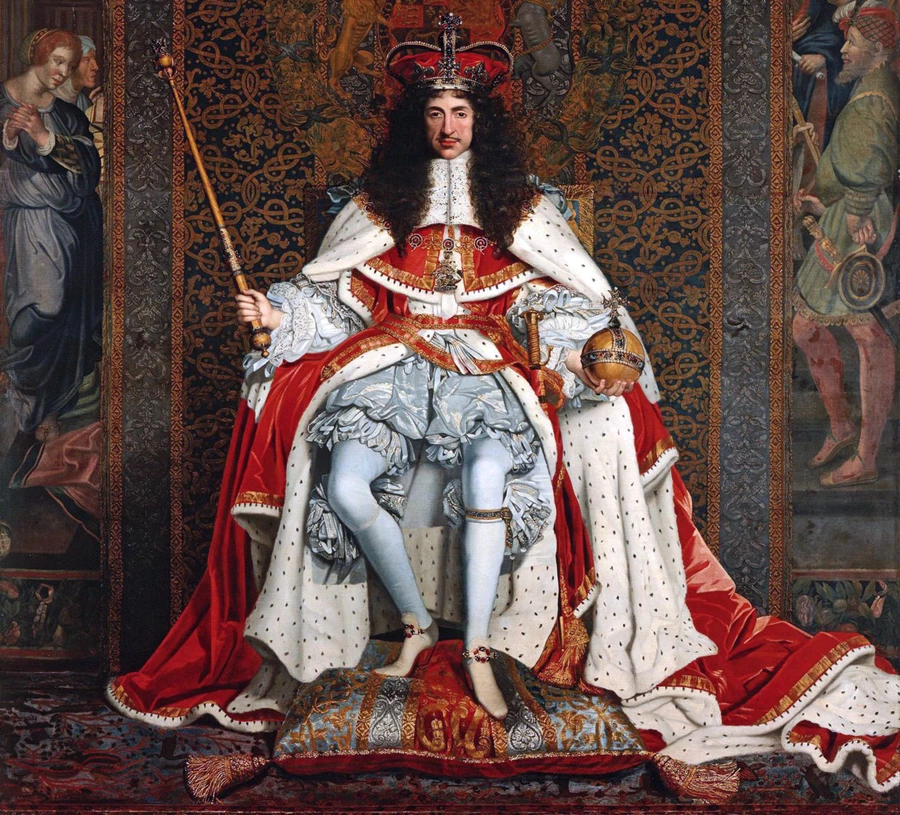
Image credit: Detail of coronation portrait of Charles II of England by John Michael Wright, Public domain, via Wikimedia Commons
Intellectuals and politicians often try to verbally summarize or justify conventional thinking in pithy ways. Milton Friedman (in 1965) and Richard Nixon (in 1971) both said different versions of the phrase “we are all Keynesians now.” . . . Friedman and Nixon were describing the thoughts behind the implementation of Great Society redistribution programs and an inflationary monetary policy designed to offset the cost of those programs.—Brian Wesbury and Robert Stein, We Are All Keynesians Now
If there is one central myth supporting the folly that passes for monetary policy and by extension fiscal policy, it would have to be the unchallenged assumption that money should be defined and controlled by government.
Given the role of money in the economy—that it serves as a trade intermediary, one half of virtually every transaction—nothing has been more destructive to the well-being of most people than the government’s usurpation of money from the market.
Money was once the most marketable commodity, albeit a special commodity. Unlike other commodities such as oil or corn,
gold lasts forever. If someone uses gold, it remains to be used again. . . . If oil production stops, so does our supply of oil. If gold mining stops, we don’t lose our supply. All gold ever mined is still here with us and will stay with us forever.
Today, money is whatever the government says it is, and since 1933 in the US, it has been pieces of paper or their digital substitutes issued by the central bank and its members, the commercial banks.
What’s wrong with having the government or its agent, the central bank, define money and regulate its supply, which in practice means regulating the rate at which the supply is increased?
First, the money is not theirs—it doesn’t belong to the government or the central bank. Banks legitimately get their funds from depositors or investors. Anything they create on their own through fractional-reserve lending is fraudulent because they’re guaranteeing the same dollar to both a borrower and a depositor. Government gets its revenue through the threat of violence (taxes) and cannot rightfully claim ownership of any of it.
Property rights violations notwithstanding, why is this a harmful arrangement economically? Because the government-supported banking system is a counterfeiting racket. The act of counterfeiting money consists of duplicating the legal tender or standard currency and passing it off as legitimate. The counterfeit money does not represent goods or services produced. The subsequent increase in the supply of money puts downward pressure on the purchasing power of the monetary unit so that holders of previously existing money are in effect paying for the counterfeiter’s purchases.
Murray Rothbard discusses the counterfeiting process in his bookWhat Has Government Done to Our Money?:
Counterfeiting is evidently but another name for inflation—both creating new “money” that is not standard gold or silver, and both functioning similarly. And now we see why governments are inherently inflationary: because inflation is a powerful and subtle means for government acquisition of the public’s resources, a painless and all the more dangerous form of taxation. (emphasis added)
And according to Keynes, not “one man in a million” is able to detect the theft—which apparently includes economists who believe “inflationary monetary policy . . . offsets the cost of those [Great Society] programs.”
Kings of old could debase their coins and pass them off as the real thing, but this was a slow, tedious process that didn’t yield much revenue. Not only that, people grew wise to it and found ways to tell a cheat from a genuine article. And they saw it as a cheat, not as a way of increasing gross domestic product, or making the price of exports more competitive, or stabilizing the price level.
Paper money changed all that.
People deposited their gold and silver in banks for safekeeping, then used the paper claims to the metal as convenient substitutes for money. Bankers soon proved they couldn’t be trusted. When note holders and depositors came running to redeem their rightful claims and the banks proved unable to comply, the government allowed the banks to turn them away empty-handed while remaining in business.
Slamming the doors on legitimate note holders and depositors was embarrassing to the banks, not to mention unprofitable. Thus, in the US the biggest bankers got the government to impose the Federal Reserve on our lives. Economist Joe Salerno describes Rothbard’s view of the Fed as “a cartelizing device that limits entry into and regulates competition within the lucrative fractional-reserve banking industry and stands ready to bail it out, thus guaranteeing its profits and socializing its losses.”
“Socializing its losses”—that’s where we come in.
For a few years there was a serious problem with this arrangement: gold stood in the way. From the counterfeiters’ perspective, the beauty of paper money was that it all looked the same.
Gold was subsequently framed as one of the causes of the Great Depression, and by decree paper, the money substitute, became money itself. The president the people elected seized their gold and locked it up in the United States Bullion Depository at Fort Knox. As dollars can now be created with a few keystrokes, it has proven trivial to fund trillion-dollar deficits.
Today, the rich are getting richer and the poor are getting poorer not because of “capitalism,” but because of a government-supported monetary system that enriches designated counterfeiters and their beneficiaries at the expense of other dollar holders.
Milton Friedman, in my view, penned the most important statement ever on monetary policy: “If a domestic money consists of a commodity, a pure gold standard or cowrie bead standard, the principles of monetary policy are very simple. There aren’t any. The commodity money takes care of itself.”
Given that monetary policy today consists of varying degrees of counterfeiting, we need to get government out of the way and let the market-designated money—whatever it may be—take care of itself.
On the morning of June 14, 2022, a new mural was unveiled above the entrance to Leavitt’s Country Bakery in the small town of Conway, New Hampshire (pop: 9,822). Inspired by the nearby White Mountains, the mural features a mountain range—of pastries. The whimsical idea and style was a perfect fit for the small-town bakery, and certainly a step up from the drab wooden façade that preceded it.
The mural had been painted by three local high school students as a project for their art class, and the unveiling was attended by many students and community members, including the local press.
“There were a lot of late afternoons,” said Olivia Benish, the art teacher who oversaw the project. “I wanted to give my top students a project, and they really did a great job.”
The project took 80 hours for the students to complete, which they put in over the span of five weeks.
“I’ve never done such a big piece of art before. So it’s pretty exciting,” said Morgan Carr, one of the artists.
Leavitt’s’ owner Sean Young was also pleased with the mural, and he was especially proud that he was able to partner with the high school on the project.
“We thought it would be a fun project for the kids and good for the community,” said Young. “Hopefully this will be an annual project, as we have other sides to the building.”
Unfortunately, this isn’t the end of the story. A week later a town official showed up to the bakery and informed Young that the mural violated a local zoning ordinance which places a limit on the allowable size of store signs. According to the town, the Leavitt’s building can’t have a sign more than 22 square feet. The mural, being 91 square feet, far exceeds that. Thus, according to officials, the mural must come down.
It’s worth noting that Conway has many large murals, all of which the town allows. So what’s different about this one? According to officials, this mural counts as a “sign” because it depicts the kinds of things the store sells, namely pastries. In other words, if the mural had depicted real mountains—or anything else for that matter—there would be no problem.
There would also be no problem if this exact same mural were displayed somewhere else. In fact, town officials told Young that if he moved the mural to the farm stand next to the bakery—which is on the same lot—then it could stay up because the farm stand doesn’t sell baked goods.
Despite immense public backlash, the town has put its foot down and is insisting the mural be removed or changed. Near the end of 2022 they threatened Young with enforcement proceedings. If he doesn’t remove or paint over the sign, he could face criminal charges and fines of $275 per day.
But rather than acquiesce, Young has chosen to fight back. On January 31, he teamed up with the Institute for Justice (IJ) to file a federal lawsuit against the town, arguing that the zoning ordinance violates his First Amendment rights.
“Government bureaucrats don’t get to play art critic and decide what is and isn’t art,” said IJ Senior Attorney Rob Frommer. “Leavitt’s could legally have a mural the exact same size if it didn’t show any items they sell. That makes no sense and violates the First Amendment.”
“I couldn’t believe the town was going after me for giving high school students a way to express their artistic passions and contribute something fun and delightful to the community,” said Young. “This mural isn’t hurting anyone. If anything, it has brought the community together.”
The Case against Zoning Laws
What’s remarkable about the zoning law at the center of this story is precisely how unremarkable it is. There are thousands of laws just like this across the country, and they’ve become so commonplace that we rarely even think about them. Only when a story like this comes along do we even consider that they might be a tad intrusive.
It wasn’t always this way. When zoning laws were first introduced around the beginning of the twentieth century, they were hotly debated. Over time, however, people gradually gave up fighting them, and now we mostly take them for granted.
Not only have zoning laws faced less opposition over time, they’ve also become far more stringent. Municipal and county ordinances now regularly include such restrictions as how tall you can build, how densely you can build, how far back from the street your building must be, what the property can be used for, and even very specific rules like what size of signs you can have, as this story illustrates. What started as “you can’t build a skyscraper there” soon became “you can’t build an apartment there if it doesn’t have at least 20 parking spaces.”
The main argument in favor of these laws is that they help preserve the character of a community. Without these laws, the reasoning goes, you’d have brothels next to schools and lumber mills next to residential neighborhoods. Obnoxious signs would be everywhere…you get the picture.
Proponents also argue that these laws help maintain property values (“stabilize” is the euphemism). After all, if the place across the street is allowed to be trashy, that’s sure to have a negative impact on the value of your home.
The primary argument against zoning laws revolves around property rights (though in court it’s often more effective to argue the First Amendment angle, as IJ is doing in this case). In short, people should be allowed to do what they wish with their own property. Government control violates your liberty as a property owner and is thus unethical.
In response to the apprehension that widely incongruous land uses might be juxtaposed, such as brothels and schools, opponents of zoning laws would argue that these fears are largely overblown, because such uses would make little practical sense anyways. Further, in the few cases where such problems might arise, voluntary arrangements such as restrictive covenants could easily prevent unwanted developments. Similar arrangements could likewise be made to address other issues like setbacks and signs.
As for the argument that zoning laws are needed to maintain property values, detractors simply argue that this is not an ethically legitimate reason to control someone else’s property. Property owners worried about losing equity can propose voluntary agreements with developers, but they shouldn’t get to dictate what someone else does on their land. Should a company be allowed to cripple their competitor’s business with burdensome land-use regulations on the ground that the competitor was hurting the value of their business?
Are Zoning Laws Constitutional?
In addition to the moral debate, there’s also a debate as to whether zoning laws are even constitutional. That may seem like a settled issue today, but it was far from settled in the early twentieth century.
One of the main constitutional arguments against zoning laws is that they violate the Fourteenth Amendment, specifically the “due process” clause. As per the Fourteenth Amendment, “…nor shall any State deprive any person of life, liberty, or property, without due process of law.”
The argument is that when a government enacts a zoning ordinance it is in effect depriving a property owner of their property rights and liberty without due process, because it is restricting what they can do on their land.
The constitutional debate reached a climax in the 1926 landmark Supreme Court case Euclid v. Ambler. In that case, the Supreme Court ruled that zoning laws were constitutional because they were a form of nuisance control and therefore a valid exercise of police power.
Though various legal challenges (such as First Amendment challenges) continue to be mounted against specific zoning laws to this day, the constitutionality of zoning laws as such has largely been conceded.
As one would expect, zoning laws became much more prevalent in the wake of this ruling.
Meddling with Minutiae
While the practical consequences of zoning laws are debatable, it’s hard to dispute that they’ve at least caused a great deal of conflict and strife. Every new development seems to be a battle. The tiniest minutiae regarding land uses have been litigated to death in city halls and courts across the country. Not only is this a tremendous waste of time and resources, it’s also rather detrimental to our culture.
When even the smallest details regarding a property fall under the purview of government, the inevitable result is a society of busybodies. Everyone is constantly minding everyone else’s business, and petty grievances are taken way too seriously. Those who are particularly officious are promoted to the noble position of “enforcer” and are encouraged to interfere whenever the letter of the law gives them an excuse to justify their jobs.
Surely, we have better things to be doing than this.
The Roman historian Tacitus (AD 56 – 120) summed up the problem with a timeless aphorism. “The more corrupt the state, the more numerous the laws,” he wrote.
The bureaucrats in Conway, New Hampshire would do well to reflect on these words.
Bernie Sanders and other politicians have made socialism attractive to voters, especially young ones, because it promises to eliminate the injustices of capitalism. As to what socialism and capitalism mean, no one seems to care much, other than that by socialism, they mean a kinder, caring society without income extremes, whereas capitalism is the preferred system of ruthless exploiters who amass obscene fortunes while real workers struggle to survive.
In recent times capitalism has been broadly disparaged, including for attacks on Mother Earth and the air Al Gore breathes.
Tax-avoiding companies represent various industries and collectively enjoyed almost $40.5 billion in U.S. pretax income in 2020, according to their annual financial reports. The statutory federal tax rate for corporate profits is 21 percent. The 55 corporations would have paid a collective total of $8.5 billion for the year had they paid that rate on their 2020 income. Instead, they received $3.5 billion in tax rebates.
Clearly, income taxation as it exists is grossly unfair even if it is legal. Something must be done if society is to have a future. If taxes are the price we pay for civilization, and society is demonstrably uncivilized, there’s a bug in the system somewhere. But where? Today’s socialists think they know.
It’s not necessarily a case of the super-rich wanting to exert their power over the poor. According to Forbes, “At least a dozen billionaires have made public statements that call for the super-rich to pay more in taxes.” Some mega-rich individuals such as Warren Buffet apparently feel guilty and want government to swipe more of their income. However, surrendering income to a mega thief whose appetite is insatiable doesn’t balance the scales.
If people, regardless of income, had the choice of keeping what they earned, how many would instead turn it over to the government? In all likelihood, they would avoid all thieves, who have a way of wasting what they steal. Instead, people would likely direct more of their money into philanthropic activities, as the super rich did before the Sixteenth Amendment made income theft legal.
So, What Is the Solution?
We need to ask ourselves: Is thievery necessary for civilization? Does making it legal make it any less larcenous? Does stealing more from those who have it add a luster of righteousness to theft?
Most of us were raised with the notion that theft is theft and theft is wrong. If a thief can be duped, so much the better.
The super rich, well aware of their vulnerability, have used the law to protect themselves, as Donald Trump’s now-famous remark to Hillary Clinton, that he was “smart” for not paying federal taxes, reminds us. If you were super rich, you would do the same. It’s merely a matter of buying the right politicians and bureaucrats to complicate the tax code.
Clearly, the oddball organization in all this is the government. It has more guns than Trump—a lot more—plus near-unanimous support from the media. The government could, if it believed its rhetoric, bring any billionaire to his knees. Alas, we are dealing with a corrupt government, easily swayed by the prospect of obscene monetary gains.
Corruption Raised to a Virtue
Once upon a time, governments discovered there are more ways to steal than through direct taxation. Kings and other tyrants noticed that their citizens trusted government coins and began diluting their precious metal content or falsifying their stamped content. The peasants caught on and hoarded the good ones, while using the king’s coins in trade. But the kings caught on and made the peasants pay taxes in good coins.
Much later, when banks got into the act, they noticed their depositors had begun using gold receipts in trade instead of the gold itself. Depositors trusted the banks, but then the banks decided to issue receipts for gold they didn’t have. Unlike the debased coins, a phony receipt looked the same as a good one. People were fooled, but eventually the banks were caught and had to shut down, at least temporarily.
Because banks dealt with money and governments could never get enough of it, the two became close friends. Government passed laws declaring that the banks owned the gold in their vaults, not the hapless depositors. It also created central banks that could control all or most of the banks of the country, as well as the economy itself.
Vera C. Smith addressed the topic of central banking in her 1936 book, The Rationale of Central Banking and the Free Banking Alternative. In the book’s preface, economist Leland Yeager tells us, “A central bank, as Smith noted, is not a product of natural development. It originates through government favors and bears special privileges and responsibilities.” Leland continues,
Typically, it serves as banker for the government and for the ordinary banks and monopolizes or dominates the issue of paper money. From this privilege derive the secondary functions and characteristics of a modern central bank: it guards the bulk of its country’s gold reserve, and its notes and deposits form a large portion of the cash reserves of ordinary banks. It is constrained under a gold standard, though less tightly than competing banks would be, by the obligation to keep its notes redeemable. When unable to meet this obligation, it typically suspends payments and goes off the gold standard, while its notes acquire forced currency. Control over the volume of its own note and deposit issue gives the central bank power over the size or scale of the country’s money and banking system and over the general credit situation. (emphasis mine)
In the US, the Federal Reserve and the federal government have had a cozy relationship for over a century. With gold redemption gone, the only receipts the Fed issues are fake ones, yet they pass as money, by decree. And by purchasing government debt, the Fed helps fund the government’s welfare-warfare expenses.
Given that the Fed has bought the economics profession, its operations are protected from reasonable scrutiny. Inflation, for instance, is usually defined as a volatile rise in the general price level—see the explanations of the Federal Reserve Bank of St. Louis, Investopedia, and the Peter G. Peterson Foundation, for example—not an increase in the money supply, as it was originally understood. The economists tell us a 2 percent price increase is not only acceptable but necessary for a healthy economy. And with its 2 percent target, the Fed is seen as an inflation fighter rather than an inflation creator.
Inflation eats away at the purchasing power of the dollar. Check it out for yourself. It’s effectively a hidden tax. Who is hurt the most: the few holding lots of dollars or the rest holding a few?
And if the few are big enough and can’t pay their bills, who do you suppose bails them out with its power of the printing press?
With the big players protected and even encouraged through what was originally termed the Greenspan put, is it any wonder large discrepancies in income result?
People say they want a level playing field. Rather than giving the known thieves more power, as today’s socialists and progressives want, the thieves should be ousted to achieve this goal.
The fifty-third annual meeting of the World Economic Forum (WEF) brought together fifty-two world leaders, seventeen hundred corporate executives, sundry artists, and other personalities to address “Cooperation in a Fragmented World.” Fragmentation is the nemesis of the World Economic Forum and its United Nations (UN) and corporate partners. “Fragmentation” means that segments of the world population are not adhering to the agenda of climate change catastrophism and the precepts of the Great Reset.
The Great Reset, meanwhile, amounts to a hybrid state-corporate woke cartel administering the global economy (and by extension the world’s political systems) under the direction of the WEF, the UN, the International Monetary Fund (IMF), the European Central Bank (ECB), and the World Health Organization, as well as top corporate decision-makers like BlackRock’s CEO, Larry Fink.
Lest we imagine that the WEF and its meetings merely represent the grandiose delusions of some ineffectual clowns, it should be noted that the WEF’s “stakeholder capitalism”—introduced in 1971 by Klaus Schwab, the WEF founder and chair, and Hein Kroos, in Modern Enterprise Management in Mechanical Engineering—has been embraced by the UN, by most central banks, as well as by the world’s leading corporations, commercial banks, and asset managers. Stakeholder capitalism is now considered to be the modus operandi of the world economic system.
In the 1971 book, Schwab and Kroos suggested that “the management of a modern enterprise must serve not only shareholders but all stakeholders to achieve long-term growth and prosperity.” The stakeholders are the compliant and complicit corporations and governments, not the citizenry.
BlackRock, the world’s largest asset manager, holds upwards of $10 trillion in assets under management (AUM), including the pension funds of many US states. In 2019, BlackRock’s CEO, Larry Fink, led the US Business Roundtable on stakeholder capitalism. CEOs from 181 major corporations redefined the common purpose of the corporation in terms of Schwab’s brainchild, stakeholder capitalism, signaling the supposed end of shareholder-driven capitalism. In his 2022 letter to CEOs, Fink made BlackRock’s own position on investment decisions quite clear. “Climate risk is investment risk,” Fink declared. He promised a “tectonic shift in capital,” an increased acceleration of investments going to “sustainability-focused” companies.
Fink warned CEOs: “And because this will have such a dramatic impact on how capital is allocated, every management team and board will need to consider how this will impact their company’s stock”(emphasis mine). According to Fink, stakeholder capitalism is not an aberration. Fink provides evidence of stakeholder capitalism’s woke imperative in his denial of the same: “It is not a social or ideological agenda. It is not ‘woke.’ It is capitalism.” This definition of capitalism would certainly have come as news to Ludwig von Mises.
Fink sits on the board of trustees of the WEF, along with former US vice president Al Gore; IMF managing director Kristalina Georgieva; ECB president Christine Lagarde, and Canadian deputy prime minister and minister of finance Chrystia Freeland, among others.
In his 2023 welcoming remarks and special address, Schwab pointed to the multiple crises facing the world: “the energy transformation, the consequences of covid, the reshaping of supply chains are all serving as catalytic forces for the economic transformation.” Incidentally, these are all factors that the WEF has promoted and/or exacerbated. And together they have added to the “high inflation, increasing interest rates, and growing national debt” that Schwab also decried.
Schwab pointed to the problem of social and geopolitical fragmentation and “a messy patchwork of powers,” alluding to the war in Ukraine. But Schwab also bemoaned “large corporate and social media powers, all competing increasingly for power and influence. As a result, the trend is again moving toward increased fragmentation and confrontation”—no doubt referring, at least in part, to the recent takeover of Twitter by Elon Musk, the loss of a major platform for propaganda and censorship. Naturally, Schwab referred to “climate change” and “viruses” as existential threats that could lead to “the extinction of large parts of our global population.” The question is whether “climate change” and “viruses” or rather the responses to these supposed menaces will be the cause of mass extinctions.
But “the most critical fragmentation” threat, Klaus argued, is posed by those who “go into the negative” and hold a “critical and confrontational attitude” to the Davos agenda—those with the temerity to oppose a global agenda of climate change catastrophism, with its attendant control over production and consumption and the virtual elimination of property and property rights for the vast majority.
A central issue that the fifty-third annual meeting addressed was “the Current Energy and Food Crises in the Context of a New System for Energy, Climate and Nature.” The theme accords with the WEF’s earlier and repeated claims that the agricultural supply chain is too “fragmented” for “sustainable” farming. “A resilient, environmentally-friendly food system will require a shift away from our current fragmented supply chains,” wrote Lindsay Suddon, chief strategy officer of Proagrica, in 2020. In Suddon’s and many other WEF papers, the “fragmentation” refrain is repeated. Sustainable farming cannot be achieved under the “fragmented” agricultural conditions that currently obtain.
As the heads of leading multilateral and commercial agricultural finance institutions, we are convinced that fragmentation within the current food systems represents the most significant hurdle to feeding a growing population nutritiously and sustainably.
Written by Wiebe Draijer, then chairman of the managing board at Rabobank, and Gilbert Fossoun Houngbo, the director general–elect of the International Labour Organization (ILO), the paper was quite telling. It warned that unless fragmentation is addressed, “we will also have no hope of reaching the Sustainable Development Goal of net zero emissions by 2050, given that today’s agricultural supply chain, from farm to fork, accounts for around 27% of greenhouse gas (GHG) emissions.”
Rabobank is one of the financial sponsors of the WEF’s Food Action Alliance (discussed below). On its website, Rabobank notes that it operates in the Netherlands, serving retail and corporate clients, and globally, financing the agricultural sector. The ILO is a UN agency that sets labor standards in 187 countries.
What interests could an international bank and a UN international labor agency have in common? According to their jointly authored paper, they have in common a resolve to eliminate fragmentation in agriculture. The banking interest in defragmentation is to gain a controlling interest in fewer and larger farms. The labor union management interest is to have more workers under its supervision and control. The banking and labor interests combined result in large farms worked by organized farm laborers—nonowners—under the controlling interest of the bank. A bonus rationale (more likely the main one) for this “scheme” is that the sustainable development goals (SDGs) of the UN’s Agenda 2030 can thereby more easily be implemented across “agricultural value chains and farming practices.” The authors conclude: “Most critically, we need to aggregate opportunities, resources and complementary expertise into large-scale projects that can unlock investment and deliver impact” (emphasis mine). “Collective action” is the “cure.”
In terms of agriculture, that is, “fragmentation” means too many discrete and disparate farms. The solution to this problem is consolidation, or the ownership of agricultural assets by fewer and fewer entities. Enter Bill Gates in the US. The “large-scale projects” will be owned by those who can afford to abide by the European Commission’s (EC) Farm to Fork Strategy. “The Farm to Fork Strategy is at the heart of the European Green Deal.” The goal of the European Green Deal is “no net emissions of greenhouse gases by 2050.” (More on the Farm to Fork Strategy and its effects on hunger and starvation below.)
The issue of food supply was addressed in a session entitled “Sustainably Served.” The summary caption for the session notes that “nearly 830 million people face food insecurity and more than 3 billion are unable to afford a healthy diet. Challenges to human and planetary health have been further compounded by rising costs, supply chain disruptions and climate change.”
The highlight of the “Sustainably Served” panel, which otherwise amounted to virtue signaling, came in the form of questions posed by an audience member, “Jacob, from America”:
I want to ask a question about food production. Last year the Dutch government announced harsh restrictions on the use of nitrogen fertilizers. Such restrictions forced many farmers to put much of their land out of production. And these policies led to 30,000 Dutch farmers protesting these government policies. And this was being done at a time when food production was already being severely curtailed because of the war in Ukraine. My questions are, one, does the panel support similar policies being implemented throughout the world? And do you support the Dutch farmers who are protesting? Do not such strict policies leading to reduced food production ultimately harm the poorest people of the world and exacerbate the problem of malnutrition?
The questioner was one of four, yet his questions dominated the rest of the session and led the moderator, Tolu Oni, and panelist Hanneke Faber, the president of nutrition at Unilever, which is based in the Netherlands, to become quite defensive. The latter replied:
I am Dutch, and our business is based in Holland. It’s a very difficult situation in Holland. I have a lot of sympathy for the farmers who are protesting, because it’s their livelihoods and their businesses at risk. But I also have a lot of sympathy for what the government is trying to do, because the nitrogen emissions are way too high. . . . So, something needs to be done. . . .
But it’s a very Dutch problem. I don’t think that you have to worry that those same solutions will have to go somewhere else.
This last statement is belied by the fact that the Netherlands is the headquarters of the WEF’s Food Action Alliance program and the site of the Global Coordinating Secretariat (GCS) of the WEF’s Food Innovation Hubs. Launched at the Davos Agenda meeting in 2021, the Food Innovation Hubs have as their goal alignment with the UN Food Systems Summit: “The role of the GCS will be to coordinate the efforts of the regional Hubs as well as align with global processes and initiatives such as the UN Food Systems Summit.” And the stated goal of the UN Food Systems Summit is to align agricultural production with Agenda 2030’s SDGs: “The UN Food Systems Summit, held during the UN General Assembly in New York on September 23 [2021], set the stage for global food systems transformation to achieve the Sustainable Development Goals by 2030.”
“Sustainability” and “sustainable development” do not mean, as the words seem to suggest, the ability to withstand shocks of various kinds—economic crises, natural disasters, etc. They mean development constrained by utopian, unscientific environmentalist imperatives, inclusive of reduced production and consumption in the developed world and the thwarting of development that would result in the production of additional GHGs in the developing world. In terms of agriculture, this entails a reduction in the use of nitrogen-rich fertilizers and their eventual elimination and the phasing out of methane- and ammonia-producing cattle. In the Netherlands, the Food Hubs initiative has already led to the government’s compulsory buyout and closure of as many as three thousand farms, which will lead to dramatically reduced crop yields from the world’s second-largest exporter of agricultural products.
The situation in the Netherlands is also part of the European Commission’s Farm to Fork Strategy. Under the Trump administration, the United States Department of Agriculture (USDA) found that adopting the plan would result in a decline in agricultural production of between 7 percent and 12 percent for the European Union, depending on whether the adoption is EU-wide or global. With EU-only adoption, the decline in EU agricultural production was projected to be 12 percent, as opposed to 7 percent should the adoption become global. In the case of global adoption, worldwide agricultural production was projected to drop by 11 percent. Further, the USDA reported:
The decline in agricultural production would tighten the EU food supply, resulting in price increases that impact consumer budgets. Prices and per capita food costs would increase the most for the EU, across each of the three scenarios [a middle scenario of adoption of Farm to Fork by the EU and neighboring nation-states was included in the study]. However, price and food cost increases would be significant for most regions if [Farm to Fork] Strategies are adopted globally. For the United States, price and food costs would remain relatively unchanged except in the case of global adoption.
Production declines in the EU and elsewhere would lead to reduced trade, although some regions would benefit depending on changes in import demand. However, if trade is restricted as a result of the imposition of the proposed measures, the negative impacts are concentrated in regions with the world’s most food-insecure populations. . . .
Food insecurity, measured as the number of people who lack access to a diet of at least 2,100 calories a day, increases significantly in the 76 low- and middle-income countries covered in our analysis due to increases in food commodity prices and declines in income, particularly in Africa. By 2030, the number of food-insecure people in the case of EU-only adoption would increase by an additional 22 million more than projected without the EC’s proposed Strategies. The number would climb to 103 million under the middle scenario and 185 million under global adoption. (emphasis mine)
Thus, we see that “sustainably served” means sustainably starved.
Another panel of note was “Stewarding Responsible Capitalism,” which featured Brian T. Moynihan, CEO of Bank of America and chair of the WEF business council, among others. An arch proponent of stakeholder capitalism, Moynihan suggested that companies that do not meet environmental, social, and governance (ESG) criteria will simply be left behind. No one will do business with such companies, he said.
Moynihan’s comments revealed the extent to which stakeholder capitalism and the metric for measuring it, the ESG index, have penetrated commercial banking. In fact, over three hundred major banks are signatories of the UN’s “Principles for Responsible Banking,” “representing almost half of the global banking industry.” Meanwhile, forty-seven hundred asset management firms, asset owners, and asset service providers have signed the UN’s six “Principles for Responsible Investment.” These principles are entirely focused on ESG compliance and meeting the UN’s Agenda 2030 sustainable development goals. ESG indexing now pervades every aspect of banking and investment businesses, including what companies they invest in, how they adhere to ESG metrics themselves, and how they cooperate with competitors to promote ESGs. Thus, the goal of the principles is to universalize ESG investing. ESG indexing raises the cost of doing business, starves the noncompliant of capital, and creates a woke cartel of preferred producers.
In the “Philanthropy: A Catalyst for Protecting Our Planet” session, US climate envoy John Kerry suggested that he and the people at Davos were “a select group of human beings, [who], because of whatever touched us at some point in our lives, are able to sit in a room and come together and actually talk about saving the planet.” Betraying the religious, cultlike character of the Davos group, Kerry suggested that his and others’ anointment as saviors of the planet was “almost extraterrestrial.” If you tell them you are interested in saving the planet, “most people,” Kerry continued, “they think you are a tree-hugging leftie liberal do-gooder.” But I submit that “most people” think Kerry and his ilk are not do-gooders at all but rather control freaks and megalomaniacs bent on controlling the world’s population.
On other panels, the speakers stated that eating meat, driving cars, and living outside the bounds of fifteen-minute cities should be disallowed.
In short, with the Davos agenda, we are confronted with a concerted, coordinated campaign to dismantle the productive capabilities in energy, manufacturing, and farming. This project, driven by elites and accruing to their benefit, is amounting to the largest Great Leap Backward in recorded history. If it is not stopped and reversed, it will lead to economic disaster, including dramatically reduced consumption and living standards. And it will almost certainly result in more hunger in the developed world and famines in the developing world. WEF chairman Schwab may outdo Chairman Mao. If we let him.
Originally published at Mises.org. Michael Rectenwald is the author of twelve books, including The Great Reset and the Struggle for Liberty: Unraveling the Global Agenda, Thought Criminal, Beyond Woke, Google Archipelago, and Springtime for Snowflakes. He is a distinguished fellow at Hillsdale College.
In 2023, more than half of states will be raising their minimum wage.
While this may sound like a recipe for disaster, recent reporting has demonstrated that it is not expected to have a significant impact on employment or wages. The reason is straightforward: wages for low-skilled jobs have risen in recent months amid strong labor demand, which has caused a labor shortage. Thus, the equilibrium wage for low-skilled jobs—precisely those jobs that would regularly be impacted by a minimum wage hike—is already above what the wage floor will be moved to in many cases.
A Wall Street Journal analysis of data compiled by MIT professor Nathan Wilmers found that “Through September, the lowest 10% of workers by income in each state earned hourly wages that were on average one-third higher than their state’s minimum wages.” The “one-third margin was the highest in at least a decade,” the Journal notes.
In some states, the difference is even more pronounced. In Minnesota, for example, the Journal found that the bottom 10 percent of earners are making about 40 percent more per hour than the state’s minimum wage would dictate. Additionally, a local paper in Michigan explained that even though their minimum wage is scheduled to rise to $10.10 per hour this year, most business owners are already paying $1 – $4 more than that for low-skilled jobs. Just one percent of Michigan workers are making minimum wage today, as opposed to 10% less than a decade ago.
Why Do Wages Rise?
It should be noted that while these gains would normally be cause for celebration, recent inflation has outpaced wage growth. This means that, in real terms, peoples’ wages have not necessarily risen. However, this is a separate issue that deserves an analysis of its own.
What is relevant to our discussion is that the phenomenon explained above demonstrates that wages are not driven higher by minimum wage hikes but rather by market forces, specifically investment and competition.
We can see how this works by considering a simplified scenario. Firm A is successful and makes a profit, which means that they have earned more revenue than is needed to cover their current costs. So, in order to grow their business further, they will invest some portion of their profit into such things as training workers in new skills or implementing new technology. These investments will likely make existing workers more productive, empowering them to generate more revenue for the firm than they could before. The competition from other firms for this increasingly-productive labor creates upward pressure on wages.
This is not some sort of free-market fantasy, but rather has been borne out empirically. Recently, such competition for labor led to wage increases for hundreds of thousands of workers at companies ranging from Walmart to Costco to Amazon.
Wages have risen even further now due to the labor shortage, as there are many firms trying to outbid one another for a limited number of workers. But employers aren’t only competing with each other; they are also competing with the factors that are keeping people out of the labor market altogether, such as unemployment benefits. Firms must convince workers that they are providing them more value than all alternatives.
In this way, we can see that wages rise for two reasons that are often, but not always, interrelated: 1) investment that increases productivity and 2) competition.
In most cases, what a minimum wage attempts to do is raise wages without changing the underlying dynamics of the market. While this can artificially raise wages for some—although not without significant tradeoffs in the form of lost jobs—it is not reflective of real market conditions.
Two Types of Minimum Wages
A cynic could argue that the fact some minimum wage hikes will be inconsequential is evidence that “raising the minimum wage does not cause unemployment.” But this would be mistaken. It is common sense that people or firms will purchase less of a good as it becomes more expensive. That is true whether we are talking about buying slices of pizza or we are talking about hiring employees. Rather, what this story demonstrates is the difference between binding and non-binding minimum wages.
When discussing minimum wages in politics, we are almost always talking about binding minimum wages. This simply means that the proposed minimum wage is higher than the equilibrium wage, thus binding employers to pay above what they would have otherwise paid. This leads to firms hiring fewer employees, all else equal.
However, in some cases, the proposed minimum wage is lower than the equilibrium wage, which means that the firm was already going to pay prospective employees more than the minimum wage would dictate. This is called a non-binding minimum wage because the new wage floor would have no impact on the employer’s incentives or behavior. It would also have no impact on the wage of the employee.
Many of the minimum wage hikes that will be going into effect in 2023 appear to be non-binding: the equilibrium wage is already higher than the new minimum wage. Thus, we will not be seeing large impacts on employment. Understanding the distinction between binding and non-binding minimum wages is crucial to remaining clear-sighted when reading headlines about how new minimum wage hikes will have little to no effect on key economic variables.
Even so, this will likely not be the case everywhere. We know that different locations have vastly different costs of living and equilibrium wages. This is the reason why, as a FEE analysis demonstrated last year, “A $15/hour minimum wage in Puerto Rico is [equivalent to] a $68/hour minimum wage in DC.”
We must keep in mind that no two jurisdictions are the same.
Wage Floors Are Not An Anti-Poverty Tool
It is a common myth that it is minimum wage hikes, not the shifting landscape of supply and demand, that lead wages to rise. Those making this argument implicitly suggest that the minimum wage is, in fact, an anti-poverty tool.
But this line of thinking is severely mistaken.
The late economist and professor Walter Williams wrote on this in The Freeman in 2007.
This assertion [that minimum wage is an anti-poverty tool] does not even pass the smell test. There are miserably poor people in the Sudan, Bangladesh, Ethiopia, and many other places around the globe. Would any of these economists propose that the solution to world poverty is a high-enough minimum wage? Whether it is Ethiopia or the United States, poverty is not so much a result of being underpaid as being underproductive.
This is absolutely true. By the logic of minimum wage advocates, there is no reason why we should not, and could not, simply raise the minimum wage to $100/hour. The issue, of course, is that a firm’s behavior is significantly determined by supply, demand, and productivity—not abstract notions of what people may “deserve.”
If we wish to pull people out of poverty—a worthy goal—then we must focus on ways to equip people to become more productive, and therefore provide more value for an employer. This is done primarily through education, skills training, and investment in capital.
Minimum wage advocates and opponents are not necessarily in disagreement about what a proper outcome looks like: fewer people in poverty. The disagreement is whether or not this can be achieved through artificial top-down schemes or must be achieved through organic investment and improving skills through education (including self education), all with an understanding that wages are determined by real market dynamics.
The latter has been demonstrated both theoretically and empirically, but the former is unfortunately far more in vogue among political elites. It is our job to work to change that.