Blog

  • Canada’s Legal Counterfeiting Ring Is a Product of Progressive Democracy

    Lee Friday – May 1, 2023

    In 1934, at the behest of Prime Minister R.B. Bennett, and with the approval of parliament, Canada’s central bank, the Bank of Canada (BOC), was founded. It began operations in 1935. Its job is “to promote the economic and financial welfare of Canada.” It is now 2023, and more than half of Canadians are living hand to mouth, a trend that has been well established for many years. How much longer do we have to wait for the BOC to do its job?

    The BOC continues to operate because its real purpose is not to promote the economic and financial welfare of Canada, but rather to promote the economic and financial welfare of Canada’s political class, including bankers, at the expense of regular citizens. The BOC is able to do this because equality under the law does not exist in a democracy, where legal privileges are granted to some people, but not all people. For example, the government says that it is legal for the BOC and the commercial banks – but no one else – to create money that did not previously exist. They even explain the process:

    The majority of money in the economy is created by commercial banks when they extend new loans, such as mortgages. . . .

    . . .  Whenever a bank makes a loan, it simultaneously creates a matching deposit in the borrower’s bank account, thereby creating new money.

    You may have to wait a few days to find out if you qualify for a bank loan, but after you qualify, the banker only needs a few seconds at his keyboard to create the money for you. As your loan is repaid, the banker destroys the principal and keeps the interest. This is how Canadian banks rake in billions of dollars in profits every year. The exclusive right to create and destroy money is the ultimate power, the source of banks’ ill-gotten gains. As Ludwig von Mises wrote:

    A government’s plans concerning the determination of the quantity of money can never be impartial and fair to all members of society. . . . It always furthers the interests of some groups of people at the expense of other groups. It never serves what is called the commonweal or the public welfare.

    When the BOC and the banks create money that did not previously exist, they are congratulated for facilitating economic growth. Anyone else who does this is punished for counterfeiting. In other words, in a democracy, the legality of a specific action is determined not by the nature of the action itself, but by whether the person initiating the action is a member of the political class. Thus, counterfeiting is legal for banks and the BOC, but not for anyone else. Counterfeiting is bad, but this double standard is worse.

    When newly created money (monetary inflation) outpaces the production of new goods, the result is price inflation, which can be more severe in specific asset classes, such as houses, where bankers have seduced borrowers with mortgages at ultra low interest rates. Bankers never acknowledge that their counterfeiting activity results in price inflation which steals purchasing power from the pockets of hard-working Canadians. According to the BOC’s own inflation calculator, the Canadian dollar has lost 25 percent of its value since 2010, 50 percent of its value since 1990, and 95 percent of its value since 1935, when the BOC began operations. The government borrows a lot of newly created money as an alternative to imposing higher visible taxes on the public. Therefore, a loss of purchasing power is best described as an inflation tax, but the political class believes that Canadians are too stupid to make this connection.

    They also believe that Canadians are too stupid to discover the truth about bank bailouts. The recent failure of Silicon Valley Bank in California elicited these comments from University of Toronto finance professor Laurence Booth, a member of the political class:

    “The big test for the Canadian banks was the financial crisis in the United States in 2008 and 2009. . . . But there was never any question about the safety of the Canadian banking system.”

    Booth is dutifully repeating the lies of former Prime Minister Stephen Harper. To this day, there remains a widespread misperception that the Canadian banking system was rock solid, head and shoulders above the rest of the world, never in need of financial assistance. This is pure myth. Canadian officials are simply less transparent than their foreign counterparts. Five banks dominate the Canadian market, and at the height of the financial crisis, they were all in deep trouble. Each of them received massive bailouts from the Canadian government, the Bank of Canada, and the Federal Reserve. Thus, the banks got their profits, their CEO’s got raises, and taxpayers got shafted, which forced hard-working Canadians to work even harder to support themselves, their families, and these bloodsucking political parasites.

    The political class offers many sophisticated arguments to justify their exclusive right to create money out of thin air, but their arguments should be dismissed because the BOC has failed to achieve its official objective. However, the absence of “equality under the law” is a far more important reason to dismiss their arguments. Politicians constantly make laws that do not apply equally to all people, and they get away with these immoral laws because most citizens attended government schools where they were taught to equate “law” with “justice.” Frédéric Bastiat warned us about confusing morality with legality:

    It would be impossible . . .  to introduce into society a greater change and a greater evil than this—the conversion of the law into an instrument of plunder. . . .

    . . . When law and morality are in contradiction to each other, the citizen finds himself in the cruel alternative of either losing his moral sense, or of losing his respect for the law—two evils of equal magnitude, between which it would be difficult to choose.

    Money is not the root of all evil, but a legally sanctioned monopolistic power to create money is nothing more than a legalized counterfeiting ring, which is the root of a lot of evil.

    Loans can be economically beneficial, but only when the money being loaned comes from our savings which we voluntarily relinquish for the term of the loan. When a bank deviates from this process and misrepresents the nature of the money being loaned, the bank is guilty of fraud. Democracy legalizes this fraud.

    The BOC must be abolished. Money and banking must be returned to the competitive marketplace. This will force the government to either cut spending or convince the public of the need to drastically increase visible taxes.

    Technically speaking, it is legal to use other forms of money in Canada, but the government actively discourages this with tax laws and legal tender laws. When the law does not hinder anyone’s freedom to use whatever form of money they choose, people tend to use money whose quantity changes very little over time, because this inspires confidence in the future value of money. History shows that money freedom tends not only to preserve the value of money, but to increase its value. Money freedom puts the responsibility for the “economic and financial welfare” of the people back where it belongs – in the hands of the people.

    Image source: Adobe Stock
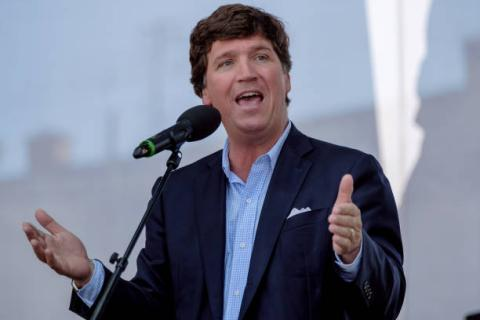
  • Why Fox Fired Tucker: BlackRock, Replacement Theory, and the ADL

    Michael Rectenwald – April 26, 2023

    Why did Fox News fire Tucker Carlson? Some claim that Tucker had planned to leave the network all along, and merely resigned. He had even had a studio built in his own home. He was fed up with Fox and decided to call it quits, so the story goes. But this theory is belied by the fact that Tucker’s production team was taken entirely by surprise by the news. For instance, I received the following text message from Scooter Downey, a producer of Tucker Carlson Originals, in response to my query after the announcement: “No idea what’s going on. Crazy!”

    Bill O’Reilly, who hosted The O’Reilly Factor, which appeared in the same time slot as Tucker Carlson Tonight, remarked that Tucker and his staff were blind-sided by the decision. “They were putting together tonight’s, Monday night’s program,” O’Reilly claimed. “They were actively involved with making the rundown as all of us do who go on television each night to talk to you. In the middle of that, boom. Tucker Carlson is history at the Fox News show. That’s how fast it came.”

    The other major explanation given for Tucker’s separation from Fox has to do with the settlement of the Dominion Voting Systems defamation lawsuit. But the suit was filed in March of 2021 and Tucker wasn’t dismissed until April 24, 2023. Dominion demanded $1.6 billion and settled for $787.5 million. Tucker’s dismissal from Fox was not a condition of the settlement. Meanwhile, as Megyn Kelly pointed out, Tucker was not even among the promoters on Fox of the theory that elections had been rigged using Dominion. “He was not a reason for that 800-million settlement,” says Kelly.

    Further, Tucker’s show was no doubt a leading money-maker for the network, or a major means for paying the damages. Why would Fox get rid of an income generator like Tucker Carlson just as the bill came due? The answer is that Fox is not as concerned about making money as it is about being a faithful servant of the regime.

    Tucker crossed significant establishment redlines and has finally suffered the consequences. He consistently argued that the ruling elite hates the majority and consistently attacks it, that national sovereignty is being eroded, and that the electorate is being replaced. The redlines included his criticism of Volodymyr Zelensky and the U.S. involvement in the Ukrainian war, his criticism of the covid responses that destroyed the economy, his questioning of the vaccines, and his targeting by the Anti-Defamation League (ADL) for various “offenses.”

    In February, BlackRock Inc. increased its position in Fox Corporation (FOXA). BlackRock now owns 15.1 percent of the company. BlackRock’s enhanced position in Fox Corporation explains, in part, the Tucker dismissal, and it was a dismissal, not Tucker’s choice.

    Why would BlackRock, headed by CEO Larry Fink, pressure Fox News to axe Tucker? For one, Tucker was known for his scathing criticism of Ukraine’s corruption, which put him at odds with the investment giant. In January, Carlson reacted derisively to a video of Ukrainian President Zelensky thanking BlackRock, J.P. Morgan, and Goldman Sachs for “rebuilding” the country. Tucker referred to Zelensky, not as a hero, as the establishment would have it, but as a dictator. Carlson has also been critical of BlackRock’s push for environmental, social, and governance (ESG) investing, claiming, rightly, that ESG is a means of circumventing legislation and thus subverting democratic processes. ESG thwarts the will of the people and installs a “climate change” dictatorship in its place.

    BlackRock also has enormous holdings in pharmaceuticals companies, as one of the three largest shareholders of Pfizer, Johnson & Johnson, and Merck. And Tucker recently interviewed Robert Kennedy, Jr. A presidential candidate, Kennedy has lambasted the covid-19 vaccines as “deadly and worthless.”

    Perhaps most significant was the ADL’s calls for Tucker’s removal. Tucker consistently claimed that the Democratic Party is attempting to replace the American electorate with illegal immigrants and the ADL called for Tucker to be de-platformed for holding to “the Great Replacement Theory,” as well as other views that the ADL forbids. The ADL had consistently pushed for Tucker’s dismissal. On The Megyn Kelly Show, after Kelly noted that the ADL was once again pushing for Tucker’s firing, Tucker said, “fuck them.” And Tucker struck back at the ADL on his own show.

    Following Tucker’s dismissal, the ADL’s Jonathan Greenblatt celebrated Tucker’s firing on Twitter, where he also accused Tucker of spewing “antisemitic, racist, xenophobic and anti-LGBTQ hate to millions.” He also acknowledged that the ADL had “long called for his firing”:

    It’s about time. For far too long, Tucker Carlson has used his primetime show to spew antisemitic, racist, xenophobic and anti-LGBTQ hate to millions. @ADL has long called for his firing for this and many other offenses, including spreading the Great Replacement Theory.

    The Dominion defamation suit was not the impetus for the removal of Tucker Carlson from the Fox News line-up. Nor did Tucker walk out of Fox on his own accord. Tucker was axed by the regime’s henchmen, who work together to silence dissent, pummel the population with endless propaganda, and gaslight their victims with lies that represent the precise inverse of the truth. As a propaganda apparatus of the ruling class, Fox News is not primarily interested in profit. Its raison d’être is to serve as controlled opposition. And Tucker was out of the establishment’s control.

    “The media,” Tucker recently said, “are part of the control apparatus…not only are they part of the problem, but I spent most of my life being part of the problem, defending the Iraq War, like I actually did that.” That is, Tucker came to recognize that the media are ideological state apparatuses whose functions are to indoctrinate, mislead, and support the reigning regime and their narratives, whether past, present, or future. Tucker attempted to subvert those media functions and became a danger to the regime. It is no wonder that he no longer works for Fox News. The question is how he lasted so long.

    Originally published at Mises.org. Michael Rectenwald is the author of twelve books, including The Great Reset and the Struggle for Liberty: Unraveling the Global Agenda, Thought Criminal, Beyond Woke, Google Archipelago, and Springtime for Snowflakes. He is a distinguished fellow at Hillsdale College.

  • More School Districts Ban ChatGPT. Here’s Why That’s A Bad Idea.

    Kerry McDonald – April 24, 2023

    Humans have a complicated relationship with new technologies. We generally appreciate the ways in which they improve our lives in the long run but tend to be wary of them in the near-term. In my Unschooled book, I describe an example of a new technology that many people thought would be the downfall of society. One journalist warned: “We shall soon be nothing but transparent heaps of jelly to each other.” 

    What was that new technology that caused such worry?

    The telephone.

    Today, new technologies often elicit similar worries. For example, there have been mounting calls to ban youth social media usage over fears of its impact on children’s mental health. More recently, several school districts have blocked student access to ChatGPT, the new artificial intelligence bot from OpenAI that within seconds can draft eloquent essays on any topic. 

    It’s this high-quality drafting that has many school administrators and education thought leaders in a panic. Officials in the New York City public school district blocked student ChatGPT access last month. Los Angeles, Oakland, Seattle, and Baltimore school districts created a similar ban, as have districts in Alabama and Virginia. Other schools are considering related restrictions.

    A main concern about ChatGPT is that students will use it to cheat. The speculation is that students will ask the tool to draft content for them that they can then incorporate into essay assignments, taking the words as their own. This is, of course, cheating and has long been a problem in schools and colleges worldwide. 

    While some are defending ChatGPT in classrooms, others are deeply concerned about this new technology and its impact on student learning. One education commentator recently quipped that ChatGPT could be the catalyst to bring back penmanship and avoid type-written essays altogether. Another suggested that ChatGPT could mean the end of the “flipped classroom,” with essay writing returning to the classroom, rather than the student’s home, as students write under the watchful eye of a teacher.

    As with social media bans that fail to look more deeply at why young people are anxious and depressed, blocking ChatGPT also doesn’t address the root problem: Why do kids cheat? 

    Students generally cheat because they are uninterested in the topic or assignment and therefore find no motivation to produce authentic work tied to real learning. They may also cheat if they think the stakes are so high that their own efforts wouldn’t be good enough, as is the case with students who pay others to write their college entrance essays.

    If a student is producing work for a class that she has voluntarily selected, tied to a genuine passion for the topic, and in pursuit of her own self-directed goals, cheating isn’t an issue. When individuals are intrinsically motivated to pursue knowledge and produce content, cheating isn’t advantageous.

    Just as our system of forced schooling may be contributing much more to the youth mental health crisis than are new technologies, forced schooling is also the primary reason why students cheat.

    As Boston College psychologist Peter Gray writes: “Our system of compulsory (forced) schooling is almost perfectly designed to promote cheating. That is even truer today than in times past. Students are required to spend way more time than they wish doing work that they did not choose, that bores them, that seems purposeless to them. They are constantly told about the value of high grades. Grades are used as essentially the sole motivator. Everything is done for grades. Advancement through the system, and eventual freedom from it, depends upon grades.”

    Rather than blocking young people from using new technologies, and surveilling them even more, let’s instead err on the side of freedom. This includes granting young people the freedom to use the new technologies that shape our world, as well as granting them the freedom to learn in more non-coercive, self-directed ways, in pursuit of their own joyful interests.

    Perhaps we will become “nothing but transparent heaps of jelly to each other,” as the 19th century journalist warned, but I’m betting against it. Humans thrive with freedom and the technological progress that freedom spawns.

    Reprinted from Fee.org. Kerry McDonald is a Senior Education Fellow at FEE and host of the weekly LiberatED podcast. She is also the author of Unschooled: Raising Curious, Well-Educated Children Outside the Conventional Classroom (Chicago Review Press, 2019), an adjunct scholar at the Cato Institute, education policy fellow at State Policy Network, and a regular Forbes contributor. Kerry has a B.A. in economics from Bowdoin College and an M.Ed. in education policy from Harvard University. She lives in Cambridge, Massachusetts with her husband and four children. You can sign up for her weekly email newsletter here.

    Photo by Steinar Engeland on Unsplash

  • Endangering Washington’s Divine Right to Deceive

    James Bovard – April 18, 2023

    Do Americans have the right to know if the $100 billion in their tax dollars that the Biden administration is delivering to Ukraine is being wasted? No, according to the U.S. Congress – which recently voted against creating an Inspector General to investigate whether handouts to the most corrupt government in Europe were being stolen.

    Do Americans have the right to know if their own government blew up the Nord Stream pipeline, the biggest act of environmental terrorism in history? The Washington Post reported that the message from the U.S. and western European governments is “Don’t talk about Nord Stream.” So almost all reporters were “good boys” and moved along.

    Do Americans have the right to know if Biden administration officials have perennially made false statements about the prowess and victories of the Ukrainian army fighting the Russians?

    No, according to Washington journalists who proudly fly Ukrainian flags on their own lavish homes.

    Regardless of the horrendous death tolls suffered by both the Ukrainian and Russian armies, the Powers That Be in Washington are doing just fine and living comfortably.

    Except for another damn leak.

    In the last 10 days, Washington has been rocked by leaks of top secret information on Ukraine, Russia, Israel, and a few other topics. The response by the Washington establishment and media is akin to the mob in “Monty Python’s Life of Brian” who stoned an old man who said the word “Jehovah” out loud.

    On Thursday, the FBI arrested Jack Teixeira, a 21-year-old Massachusetts Air National Guard member. He was charged with retention and transmission of national defense information and willful retention of classified documents. According to the Washington Post, a friend said that Teixeira was “a devout Catholic and a libertarian with an interest in guns and doubts about America’s future.” A Post editorial noted that the alleged culprit had “complained of government overreach,” so obviously he was up to no good.

    At this point, it isn’t clear whether Teixeira intended to leak the documents or whether people on the Discord gaming group where the documents were allegedly posted chose to make them public without his permission. His motivation is unclear.

    The documents reveal that the Ukrainian military is in far worse shape than the Biden administration claimed. The expected Spring offensive by the Ukrainian army will likely be a flop if not a disaster. They reveal that the Ukrainian government was behind an attack in Belarus. The documents also contained embarrassing information on Israel’s Mossad, the Russian government, and U.S. spying on South Korea.

    Thus far, it appears that none of the information that allegedly came out via Teixeira has endangered the lives of any U.S. soldiers or American citizens. But Teixeira is guilty of exposing boatloads of bootlickers and liars in Washington.

    White House National Security spokesman John Kirby warned the media that the leaked documents are “not intended for public consumption… This is information that has no business in the public domain.”

    Unfortunately, that is how federal policymakers feel about almost all the information regarding U.S. foreign policy. That’s why the government creates trillions of new pages of secrets per year.

    According to local legends, there was a bygone era when Washington journalists fought zealously to expose government cover-ups. But the response to the latest leaks makes that story difficult to swallow.

    New York Times military correspondent David Philipps tweeted, “The NYT worked feverishly to find the identity of the guy leaking [Top Secret] docs on Discord. Ironically, if the same guy had leaked to the NYT, we’d be working feverishly to conceal it.” (Philipps wasn’t endorsing that fever.) Journalist Michael Tracey scoffed, “Contributing writer at The Atlantic @AmyZegart declares the real ‘heroes’ of the week were all the amazing journalists who participated in a ‘dragnet’ to identify the leaker, at which time the FBI ‘moved into action’ and nabbed him. A true landmark feat of journalistic heroism.”

    The Washington press corps showed vastly more enthusiasm for tracking down the leaker than for discovering who bombed the Nord Stream pipeline. At a Pentagon press conference, journalists showed far more indignation about the breach of federal secrecy than about the lies that the documents exposed. (Here’s a film clip of journalists demanding “that more be done to prevent future leaks.”)

    Don’t expect the Fourth Estate to fess up to their conflict of interest. Many of the reports on the leaker are written by people who previously peddled official lies on Ukraine and other topics. When the Biden administration exploits the leak to further suppress freedom of speech on the Internet, expect most of the Washington press corps to cheer him.

    Will the uproar over the leaks spur some Americans to recognize how their “self-government” has become a parody? The Biden administration is tacitly invoking a divine right to continue deceiving the American people regarding Ukraine and a boatload of other foreign policies. But supposedly, everything Biden and his appointees do automatically incarnates “the will of the people” because of tens of millions of mail-in ballots a few years ago. It doesn’t matter if Biden seems perennially confused or unaware of where he is or what he is saying. Is the “holy ghost of democracy” hovering over Biden’s shoulder thanks to “Vox Populi, Vox Dei”? Unfortunately, the answer is classified.

    Are we defaulting to the “cannon fodder version of democracy”? Do Americans have the right to know if the Biden administration is dragging them into World War Three? Unfortunately, few mainstream media outlets have either the curiosity or the courage to doggedly investigate and expose the possible perils of the Biden administration’s escalation of the Ukraine-Russia conflict. Biden’s appointees have vigorously opposed any ceasefire in that war. It is a national disgrace that such comments have not spurred widespread outrage at Team Biden’s efforts to perpetuate the carnage. A Washington Post editorial condemned the alleged leaker: “Breaking the laws for a psychic joyride is a despicable betrayal of trust and oaths.” But what about the media’s complicity in championing a war that makes the Hearst newspapers’ campaign for war with Spain in the 1890s look like child’s play?

    Almost no one who condemns leaks of confidential information offers any alternative for Americans learning what “their” government is doing. As long as average Americans stay in their place, paying and obeying, everything will work out fine – at least for Washington real estate values. If democracy is now little more than a system where insiders deceive people for their own good, how is it different than all the other regimes that oppressed people throughout history?

    Originally published at Mises.org. James Bovard is the author of ten books, including 2012’s Public Policy Hooligan, and 2006’s Attention Deficit Democracy. He has written for the New York Times, Wall Street Journal, Playboy, Washington Post, and many other publications.

    Image source: Adobe Stock

  • Peace is Breaking Out in the Middle East…and Washington is Not Happy!

    Ron Paul – April 16, 2023

    While we were being distracted by the ongoing Russia/Ukraine war – and Washington’s increasing involvement in the war – tremendous developments in the Middle East have all but ended decades of US meddling in the region. Peace is breaking out in the Middle East and Washington is not at all happy about it!

    Take, for example, the recent mending of relations between Saudi Arabia and formerly bitter adversaries Iran and Syria. A China-brokered deal between the Saudis and Iran has them re-establishing full diplomatic relations, with the foreign ministers of both countries meeting in Beijing last week. It is the highest level meeting between the two countries in seven years.

    Additionally, Riyadh is expected to invite Syria back into the Arab League and Syrian president Assad may attend the next Arab League summit. Syria was suspended from the Arab League 12 years ago when then-US allies in the Middle East signed on to Washington’s “Assad must go” policy that wreaked havoc across the region.

    And the nearly decade-long war in Yemen, which has devastated that population, appears to finally be ending, as Saudi Arabia is expected to announce an end to its US-backed war on that country. Troops from the United Arab Emirates are leaving Yemen and a Saudi delegation is arriving to negotiate a peace deal.

    To normal people the idea of peace breaking out in the Middle East is a wonderful thing. But Washington is anything but normal. President Biden dispatched his CIA Director, William Burns, to Saudi Arabia in a surprise visit last week. According to press reports, Burns was sent to express Washington’s surprise and frustration over the peace deals going through. Biden’s foreign policy team “has felt blindsided” by Saudi Arabia’s sudden move to get along with its neighbors.

    Washington is angry that Saudi Arabia will start trading with Syria and Iran because those two countries are still under “crippling” US sanctions. One by one, as these countries begin ignoring US-demanded sanctions, the entirety of US foreign policy is being exposed as a paper tiger—just bluster and threats.

    Middle East developments have revealed a dirty secret about US foreign policy. Washington has for a long time used a “divide and conquer” strategy to keep countries in the Middle East – and elsewhere – at each other’s throats. Sanctions, covert operations, and color revolutions have all been used to make sure that these countries do not get along with each other and that DC controls who runs the show.

    As unlikely as it may seem to some, China has moved into the region with a different policy. China seeks business partners, not to manipulate the internal politics of the Middle East. They may be ruthless in their own way, but it is suddenly clear that the countries of this region are tired of US meddling and are looking for new partners.

    We non-interventionists are often attacked as “isolationists,” but as I have always said, it is the neocons and interventionists in Washington who are really isolating us from the rest of the world. Nowhere is that more evident these days [than] in the Middle East. It didn’t have to be this way, but if this is the end of US meddling in Middle East affairs then ultimately it is a good thing for the American people…and for peace.

    Originally published at Mises.org. Dr. Ron Paul is a former member of Congress and Distinguished Counselor to the Mises Institute.

    Image source: Adobe

  • How Politicians Use Regulations to Deflect Blame

    Patrick Carroll – April 13, 2023

    Listen to the Audio Mises Wire version of this article.

    The pro-life activist Randall Terry has a famous quote that anyone who cares about politics should be familiar with: “He who frames the question wins the debate.”

    Politicians are well aware of this fact, which is why they spend much of their time directing the political conversation into frameworks that benefit them. If they can get us arguing over how best to “reform” the education system, for instance, there will be little discussion about the bigger question of whether education should be handled by the state at all. It doesn’t really matter how the reform conversation goes after that. The framing that every reform combatant implicitly buys into grants that education should be handled by the state. The educational establishment wins before a single shot is even fired.

    Another way politicians like to influence the framing of debates in their favor is with regulations. A few examples will help to illustrate how this works.

    Minimum Wage Laws

    There has been a vigorous debate in recent years over how high the minimum wage should be. Though some say it should be higher and others say it should stay where it is or even go down, most people accept the idea that some minimum wage is necessary, and that the only important conversation is figuring out where to set it.

    The critical reframing, of course, is to challenge that assumption. The debate we need to be having is whether a minimum wage should exist at all.

    But how is the minimum wage an example of politicians framing the debate in their favor? Think about what problem the minimum wage is trying to solve, and most importantly, who is being implicitly blamed for that problem. The problem is that many poor people can’t afford a basic standard of living. The people being implicitly blamed are their employers.

    But why should the employer be blamed for what is essentially a mismatch between the income of workers and the cost of living? Why not blame the cost side for being too high? After all, a wage of five dollars per hour would be more than enough if the cost of living were lower by a factor of ten.

    Maybe it’s the grocery stores and landlords that are charging too much rather than the employers paying too little. Or maybe the blame lies with the government. Maybe the real problem is that government intervention in the economy has made the cost of living soar, and that’s why the poor can’t afford a basic living.

    If that’s true—and it seems quite likely that it is—then the blame for this problem should be directed at the government for making things so expensive, not at employers for paying too little.

    The politicians can’t have that, of course. They want to be seen as the saviors, not the problem causers—the heroes, not the villains. So, what do they do? They find a scapegoat in the form of the employer, who happens to be a rather effective one since there’s a general animosity toward employers anyways. “He is the reason you are starving,” the politicians tell us. “We will stand with the poor and downtrodden by forcing him to pay a ‘fair wage.’”

    Never mind that they are the reason the cost of living is out of reach for so many. It is always the employer’s fault. It is the employer who must pay more and more whenever the government makes life more expensive.

    Rent Control and Consumer Protection

    Many other regulations follow a similar pattern of deflecting blame from the government. Take rent control. The problem is that many people struggle to pay their rent. The proposed solution is a cap on rental rates. The people being implicitly blamed under that approach are the “greedy” landlords (another favorite scapegoat). The people actually to blame are, of course, the politicians and bureaucrats, who have set up a web of zoning laws and land-use regulations that put a major check on supply and thus push prices far above what they would be in a free market.

    Consumer protection regulations work in much the same way. The problem is that corporations sometimes deliver poor-quality products and services. The proposed solution is regulations on quality. The people being implicitly blamed are business owners. Now, it’s true that business owners don’t always conduct their businesses ethically. But again, consider how the government might be at the root of this problem.

    In many industries, the government actively restricts entry with tariffs, IP laws, licensing, and such, protecting established firms from competition. That competition is likely the key to driving bad firms out of business. The solution, then, is not to add even more regulations that ostensibly protect consumers, but to deregulate the industry so that monopolistic producers can’t get away with bad products and services.

    Challenging How Issues Are Framed

    The key thing to notice is that there is an accusation of culpability implicit in every regulation. If a regulation is aimed at you, it must be because you are the one causing the problem.

    In reality, it is often the politicians causing the problem, and the regulation is just a convenient way for them to deflect blame. And it’s surprisingly effective. Politician A argues we should regulate employers, landlords, and business owners one way. Politician B insists we should regulate them another way. Everyone picks a side, but the most important battle is already lost because the idea that group X is the problem and that regulating them is the solution has been conceded by both sides from the get-go.

    It is incumbent upon those of us who know where the blame truly lies to call this out, not only with the regulations mentioned above but wherever it happens. Practice looking for blame deflection with every policy you come across. Ask yourself, what’s the problem this is attempting to solve, and who is being implicitly blamed? Consider how other actors (often the government) might be the real culprits and how in light of that fact a completely different approach might be called for.

    Above all, don’t concede the framing. If we are content to debate the trivialities of the day and don’t insist on fundamentally redirecting blame back to the government when that’s where it rightfully belongs, we’ve already lost.

    Originally published at Mises.org.  

    Image source: Adobe Stock

  • Presidents Are Legally Immune for Their Most Dangerous Crimes

    James Bovard – April 7, 2023

    Manhattan district attorney Alvin Bragg has charged former president Donald Trump with thirty-four felonies tied to his payments to two women prior to the 2016 election. Some pundits are outraged that a former president is facing charges, and others are jubilant that Trump now has a mug shot. But this case will do nothing to curtail the most dangerous immunities that presidents possess.

    Neither presidents nor any federal officials were entitled to break the law when this nation was founded. John Taylor, a US senator, wrote in 1820 that the Constitution “wisely rejected this indefinite word [sovereignty] as a traitor of civil rights, and endeavored to kill it dead.” But the following year, Chief Justice John Marshall concocted the doctrine of sovereign immunity out of whole cloth: “The universally received opinion is, that no suit can be commenced or prosecuted against the United States; that the judiciary act does not authorize such suits.” The Supreme Court declared in 1945 that sovereign immunity is “embodied in the Constitution,” but the justices have never revealed exactly where they found it.

    In 1977, former president Richard Nixon told interviewer David Frost, “When the president does it, that means that it is not illegal.” Somewhat dumbfounded, Frost replied, “By definition?” Nixon answered, “Exactly. Exactly.” Nixon’s comments were considered scandalous at the time. But “It is not a crime if the president does it” is now conventional wisdom in Washington.

    This doctrine provides a “get out of jail free” card for any president who itches to bomb foreign nations. In 1998, President Bill Clinton launched a missile strike against Sudan after US embassies in Kenya and Tanzania were bombed by terrorists. The US government never produced any evidence linking the targets in Sudan to the terrorist attacks. The owners of the El-Shifa Pharmaceutical Industries plant—the largest pharmaceutical factory in East Africa—sued for compensation after Clinton’s attack demolished their facility. Eleven years later, a federal appeals court dismissed the case: “President Clinton, in his capacity as commander in chief, fired missiles at a target of his choosing to pursue a military objective he had determined was in the national interest. Under the Constitution, this decision is immune from judicial review.” Determinations based on secret (often false) information legally absolved presidents of any killings or calamities abroad.

    In 1999, former president Clinton attacked Serbia, killing up to fifteen hundred Serb civilians in a seventy-eight-day North Atlantic Treaty Organization (NATO) bombing campaign. Serbia had done nothing to the United States, but defense secretary William Cohen justified the bombing as “a fight for justice over genocide.” After the bombing ended, no evidence of genocide was found. Many of the Serbs remaining in Kosovo were slaughtered and their churches burned to the ground. Clinton’s attack brought on the takeover of Kosovo by a vicious terrorist clique that was condemned by the European Union in 2014 for murdering Serbs and selling their kidneys, livers, and other body parts.

    Thirty-one congressmen sued Clinton for violating the War Powers Act by attacking Serbia. A federal judge dismissed the lawsuit after deciding that the congressmen did not have legal standing to sue.

    Last year, former president George W. Bush gave a speech vehemently condemning the “decision of one man to launch a wholly unjustified and brutal invasion of Iraq.” Bush had blundered in a speech condemning Russia’s invasion of Ukraine. He realized his mistake, mentioned Vladimir Putin, then added, “But Iraq, too.” The audience at the George W. Bush Presidential Center in Dallas laughed. The humor was lost on the families of four thousand American servicemen and hundreds of thousands of Iraqi civilians who perished in the conflict.

    Bush dragged the nation into war against Iraq by conning Americans into falsely believing that Saddam Hussein was the culprit behind the 9/11 attacks. Bush also frightened people about Iraqi weapons of mass destruction. The ruse worked even though the WMDs were never found.

    After the 9/11 attacks, Bush’s lawyers assured him that the Constitution and federal law no longer constrained the president’s power. Bush White House counsel Alberto Gonzales formally asserted a “commander-in-chief override power” entitling presidents to ignore the Bill of Rights.

    Weaselly legal opinions propelled tyranny. An August 1, 2002, Justice Department memo narrowed the definition of torture (banned by federal law and the US Constitution) from suffering “equivalent in intensity” to “organ failure . . . or even death.” Call it a license to almost kill. Bush proceeded to authorize the type of torture regime that civilized nations had formally abandoned hundreds of years earlier. The Central Intelligence Agency (CIA) constructed an interrogation regime by “consulting Egyptian and Saudi intelligence officials and copying Soviet interrogation methods,” the New York Times reported. A secret legal opinion authorized CIA interrogators to engage in head slapping, waterboarding, frigid temperatures, and manacling in stress positions for many hours. CIA interrogators often did not speak the language of detainees, so they compensated by beating the hell out of them.

    While he was president, Bush denied that he had authorized torture. However, in 2010, during a book tour to promote his memoir, Bush bragged about authorizing waterboarding, which had been categorized as torture by the US government for more than fifty years. Torture victims who survived filed lawsuits in federal court. However, judges dismissed all the cases due to sovereign immunity.

    When Barack Obama was elected president in 2008, many Americans expected the government to show more respect for the Constitution. But Obama quickly proclaimed a presidential prerogative to assassinate Americans whom he labeled as terrorist suspects. Obama’s lawyers insisted that the president need disclose zero evidence before executing officially designated bad guys. A Justice Department lawyer declared in court in 2010 that no federal judge had authority to be “looking over the shoulder” of Obama and his targeted-killing program because those policies involved “the very core powers of the president as commander-in-chief.” A federal judge agreed, ruling that “there are circumstances in which the Executive’s unilateral decision to kill a US citizen overseas” is “judicially unreviewable.” Obama faced no peril regardless of killing at least one innocent American in a drone attack in Yemen (a sixteen-year-old boy born in Denver). Drone strikes increased tenfold under Obama, and he personally chose who would be killed at weekly “Terror Tuesday” meetings which featured PowerPoint parades of potential targets. The CIA often did not know whom it was killing but counted all adult males “in a strike zone as combatants . . . unless there is explicit intelligence posthumously proving them innocent,” the New York Times noted. Daniel Hale, a former Air Force intelligence analyst, revealed that nearly 90 percent of people killed in Obama’s drone strikes were not the intended targets. But because he was president, Obama has no liability to any of the victims or their survivors.

    Sovereign immunity creates a two-tier society: those above the law and those below it; those whom the law fails to bind and those whom the law fails to protect. Sovereign immunity presumes that the more evils government officials are permitted to commit, the more blessings they can confer—give or take ten thousand body bags. The doctrine is a parody of “government under the law.”

    But the friends of Leviathan in the nation’s courts, media, and universities assured that this perversion became standard operating procedure. As a result, America’s legal system is akin to those of Third World banana republics. “Many public officials in Africa seek re-election because holding office gives them access to the state’s coffers, as well as immunity from prosecution,” according to 2009 Council on Foreign Relations report.

    Alvin Bragg, the prosecutor who filed charges against Trump, is being widely criticized for using a novel legal theory to underlie his case. It is unclear whether Trump would have faced any legal liability under the statutes and precedents previously governing such charges. As a result, some legal experts expect the case to be speedily dismissed.

    Regardless of the fate of the Manhattan case, Americans need to end de facto immunity for commanders in chief. Thomas Jefferson warned in 1798, “In questions of power then, let no more be heard of confidence in man, but bind him down from mischief by the chains of the Constitution.” One of the best ways to make the Constitution binding is to cease blocking lawsuits against presidents for trampling Americans’ rights or inflicting carnage around the globe. But don’t expect either Republicans or Democrats to embrace that fix any time soon.

    Originally published at Mises.org. James Bovard is the author of ten books, including 2012’s Public Policy Hooligan, and 2006’s Attention Deficit Democracy. He has written for the New York Times, Wall Street Journal, Playboy, Washington Post, and many other publications.

  • Why Most of the World Isn’t on Board with the NATO-Russia War

    Weimin Chen – April 5, 2023

    Listen to the Audio Mises Wire version of this article.

    As the war in Ukraine drags on into its second year, protest demonstrations have been taking place in major European cities. They express the growing sentiment that the people are tired of the protracted conflict and fearful of what could come should the war continue even longer. Memories of the catastrophic world wars that ravaged Europe in the first half of the last century and the terrible threat of nuclear annihilation that divided the continent in the second half of the century form the traumatic foundation from which Europeans are voicing their aversion to this conflict, which has the potential to spiral out of control and bring a major war to Europe and the world again.

    Broad Opposition to War

    There have been protest demonstrations occurring in Germany, France, the Czech Republic, Greece, Spain, Great Britain, Belgium, Austria, Italy, Albania, Moldova, and others. European protests surrounding the anniversary of the start of the conflict notably span the Left-Right spectrum in opposing US-led North Atlantic Treaty Organization (NATO) imperialism as well as the economic hardships that have befallen ordinary Europeans against the backdrop of sanctions on Russia and the funding of Ukraine.

    Italian port workers aligned with the Left protested in Genoa specifically to resist the use of Italian ports to supply arms deliveries to Ukraine. Meanwhile in France, demonstrations organized by the right-wing Les Patriotes party in various locations across the country called for France’s withdrawal from both NATO and the European Union.

    In all cases, the people on the streets at these events identify involvement in the war as harmful to general economic well-being and have been expressing frustration with their countries’ acquiescence to these intergovernmental and supranational organizations in fueling the violence while simultaneously discouraging dialogue. Feelings of skepticism toward NATO, the European Union, and the United States have become increasingly vocal in Europe due to the way that western countries are handling the war. In the minds of many Europeans, their governments are recklessly following the will of Washington, which could lead them into a serious escalation to a wider war.

    German Memory

    Germany suffered tremendously during the two World Wars and continued to endure the pressures of division and foreign occupation during the Cold War. A century of pain and turmoil brought about by militarism and intervention still informs the collective consciousness of the country. As part of the anniversary protests, thousands of people gathered around the iconic Brandenburg Gate in Berlin for an event called the “Uprising for Peace,” organized by prominent Left party member Sahra Wagenknecht and the feminist journalist Alice Schwarzer. The rally was a show of support for a “manifesto for peace,” which had already received well over half a million signatures by the time of the rally. It calls for the end of military exports to Ukraine and for negotiations between Kyiv and Moscow. Demonstrations have also taken place in Nuremberg (in response to the German government’s plan to send tanks to Ukraine), in Munich (during the Munich Security Conference), and outside of the prominent US air base in Ramstein where important matters regarding the Ukraine conflict are discussed among Western leaders.

    At the rally in Nuremberg, one demonstrator recalled the historical record, explaining that if Germany gets involved in another war with Russia, then “based on history, it is the worst sign that we can send.” He emphasized that “no war must go through Germany, neither with arms deliveries nor anything else, because otherwise, Germany will be in the middle of it again.”

    The last time war broke out in Europe between the two countries, it was one of the most catastrophic events in human history. This view echoes the glimmer of hope from just a few months before the start of Russia’s invasion that the completion of the Nord Stream 2 pipeline could have strengthened ties and prevented conflict in Europe, especially with regard to Russia and Germany. Of course, the mysterious destruction of Nord Stream a year later and the report by Seymour Hersh identifying US and allied hands in the sabotage mission completely turned that hope on its head. Those who strive for peace and an end to the bloodshed are understandably disheartened, yet they are motivated to vocally speak out to European leaders to push for peace.

    Across the Atlantic and Beyond

    These gatherings have run parallel to the Rage Against the War Machine rally in Washington, DC, where Americans protested against the US’s funding and arming of Ukraine as well as the diplomatic negligence in preventing the negotiation of an end to the fighting. Those speaking and demonstrating against US involvement in Ukraine have parallel grievances toward their government and echo those in Europe.

    Voices spanning the political spectrum from socialists to libertarians have found common ground in opposing the many rounds of weapons packages and financial aid to Ukraine, as well as the lack of diplomatic responsibility on the part of Secretary of State Antony Blinken in communicating with his counterpart, Russian foreign minister Sergey Lavrov. Since the rally, President Joe Biden has included $6 billion in Ukraine and NATO funding as part of his $842 billion defense-budget request for 2024. Meanwhile, Blinken met briefly with Lavrov on the sidelines of a G20 meeting in New Delhi with no tangible progress on the subject of ending hostilities in Ukraine. While hopes from the American side remain dim, perhaps the protests in Europe may influence decisions at the levels of leadership in their respective countries.

    The West’s commitment to Ukraine has also struck opposition from other regions. At this year’s Munich Security Conference, leaders from non-Western countries expressed the necessity of finding peaceful solutions. Brazil’s foreign minister Mauro Viera called upon the world to “build the possibility of a solution,” while Colombia’s vice president Francia Marquez said, “We don’t want to go on discussing who will be the winner or the loser of a war. We are all losers, and, in the end, it is humankind that loses everything.”

    Namibia’s prime minister Saara Kuugongelwa-Amadhila stressed the waste of money and resources in the name of hostility which “could be better utilized to promote development in Ukraine, in Africa, in Asia, in other places, in Europe itself, where many people are experiencing hardships.” China went so far as to outline a political settlement to the Ukraine crisis on the anniversary of the invasion.

    These statements and efforts show their acknowledgment of the much poorer state of affairs the world finds itself in as the war drags on. The Russian war in Ukraine must come to an end one day, and more people around the world are demanding a solution now.

    Originally published at Mises.org.  

    Image source: Adobe Stock

  • Democracy Created Canada’s Pathetic Justice System

    Lee Friday – April 3, 2023

    Conservatives have been pressuring “the Liberal government to address what they term a violent crime wave, citing the killings of five police officers in five months and a surge of violence in cities across Canada.” Conservative leader Pierre Poilievre said that violent crime is up 32 per cent, gang killings are up 92 per cent, and “Police tell us that often they have to arrest the same people multiple times in the very same day because they are released again and again on bail.” Liberal Justice Minister David Lametti said “there is a need to restore trust in Canada’s justice system and address Canadians’ worries about recent violence.”

    The pathetic performance of Canada’s justice system has been evident for many decades, regardless of which party is in power. While there has been much recent concern about violent crimes committed by individuals released on bail, this is actually a standard feature of Canada’s so-called justice system:

    During a 33-year period from 1975 to 2008, some 508 criminals who, after extensive psychological testing and interviewing were judged no danger to public safety by the NPB [National Parole Board], were released from prison and in that period killed 557 perfectly innocent Canadians. [emphasis in original]

    Of the 508 killers mentioned, 10 percent were on day parole – they walked out and on the same day killed 49 Canadians.

    This high level of incompetency also infects the other two components of Canada’s justice system, the police and courts. If we define the solving of a crime as the capture and conviction of the perpetrator, regardless of sentence imposed, we discover that roughly 81% of homicides are NOT solved by the government, and their track record is even worse with crimes of rape, attempted murder, and robbery.

    Democracy Rewards Failure

    When we shop for food, clothes, cars, haircuts, electronics etc., service is linked to payment. If we do not like the product or service that we expect to receive in return for our payment, we are not obligated to complete the transaction because all transactions are voluntary. We can shop elsewhere because competition exists. Therefore, if they want to be profitable, businesses are forced to accommodate our preferences because that is the only way to persuade us to part with our money. Consumers are in control.

    In contrast, within the realm of government, consumers are ignored, competition is forbidden, transactions are compulsory, coercion replaces persuasion, and service is severed from payment. The government is in control, and it arbitrarily determines (a) the price to be charged (taxes) for a particular service, and (b) the level of service to be provided. Accountability disappears, and perverse incentives arise.

    Having stacked the deck in its favor, the government has little incentive to prevent crimes, solve crimes, or rehabilitate criminals, because less money allocated to these tasks means more money is available for exorbitant bureaucratic salaries. Likewise, government inefficiency is a magnet that attracts hordes of power-hungry politicians and bureaucrats to the microphone where they promise – yet again – that higher taxes are the solution to the criminal element. Thus, democracy rewards failure, as more power and money flow to politicians and bureaucrats in exchange for third-rate services.

    To sum up, the justice system was built according to the principles and mechanisms of democracy, which do not embody sufficient incentives to prevent crimes, solve crimes, or reform criminals with any reasonable degree of efficacy. Canada’s pathetic justice system is a product of democracy.

    However, when someone suggests that these services could be handled more efficiently in the private sector, politicians and bureaucrats again rush to the microphone to claim that essential services will quickly deteriorate if they are subjected to the whims of private entities who care only about profits. But, as we have seen, private entities can be profitable only if they provide services valued by consumers. So, the real government mantra is this: “We will forbid private entities from earning profits so that we may steal profits from taxpayers.” In other words, it is the politicians and bureaucrats, not private entities, who care only about profits. As Bruce Benson wrote:

    The fact that government law has taken over as much as it has is not a reflection of the superior efficiency of representative government . . . It is, rather, a reflection of government’s general purpose of transferring wealth to those with political power.

    Selling Victims Down the River

    Contrary to what politicians want us to believe, a criminal does not owe a debt to society, but rather to a specific, identifiable member of society – the victim. It is the victim to whom a debt must be paid, and the debt must be paid by the member of society who incurred the debt. A system that forcibly extracts resources from other members of society to support government bureaucracies and convicted criminals in government prisons is, as Benson wrote, “a reflection of government’s general purpose of transferring wealth to those with political power.” Moreover, drugs, rape, and other acts of violence are common in government prisons. This encourages recidivism, not rehabilitation, which guarantees a continual transfer of wealth to these so-called correctional bureaucracies. Meanwhile, victims are rarely compensated.

    Before kings and governments monopolized the justice system for their own benefit, the law was in the hands of the people, for their benefit. This was known as customary law (law established in recognition of evolving customs). Under customary law, when an offense was committed, victim restitution, not imprisonment, was expected. The offender must compensate his victim. To facilitate this, most people voluntarily joined mutually beneficial legal institutions based on the concept of reciprocity. This was an effective arrangement that achieved a high degree of restitution.

    Furthermore, in stark contrast to the government’s pathetic record of preventing and solving crimes, ‘victim justice’ under customary law actually discouraged individuals from committing offenses in the first place: “If I kill, rape, or steal, I know for certain that a protection agency will be hot on my trail.” Moreover, it was unlikely that dangerous offenders would be released into the community, contrary to what the government does today. Instead, these offenders would likely face capital punishment or permanent incarceration if they work hard enough to compensate their victims and cover the cost of their own confinement.

    Customary law is the enemy of democracy. In a democracy, it is illegal for private entities to produce services that would compete with government bureaucracies. In other words, the legality of a specific action is not determined by the nature of the action itself, but by whether or not the person initiating the action is a member of the political class. Thus, equality under the law disappears, political accountability disappears, and politicians routinely make campaign promises that they have no intention of keeping because democracy encourages them to lie. Special interest groups dictate government policy, while regular voters are ignored. The result is high taxation, uncontrolled spending, burgeoning bureaucracies, and massive government debt, all of which falls on the backs of the people whose opinions are routinely dismissed.

    The government also enriches its bureaucracies by redefining numerous peaceful activities as crimes even though there are no victims. Whereas, the people, if consulted, might reject these laws because, from their perspective, the cost of enforcement cannot be justified. Wasteful spending is a prominent feature of most democratic governments, where bankruptcy is a foreign concept.

    In contrast, firms in the private sector have a strong incentive to control costs because the alternative is bankruptcy. Competition ensures that entrepreneurs are motivated to offer high quality services that the people want at a price that the people are willing to pay.

    Do we want services to be provided by people operating within democratic institutions that extract profits by granting politicians legal authority to steal money from consumers’ pockets without satisfying their preferences?

    Or, do we want services to be provided by people in an unhampered market, in an environment of open competition, where consumer satisfaction is the only path to profits?

    Image source: Adobe Stock

  • Why Taxes Are Harmful: A Response to The Woke Salaryman

    Patrick Carroll – April 2, 2023

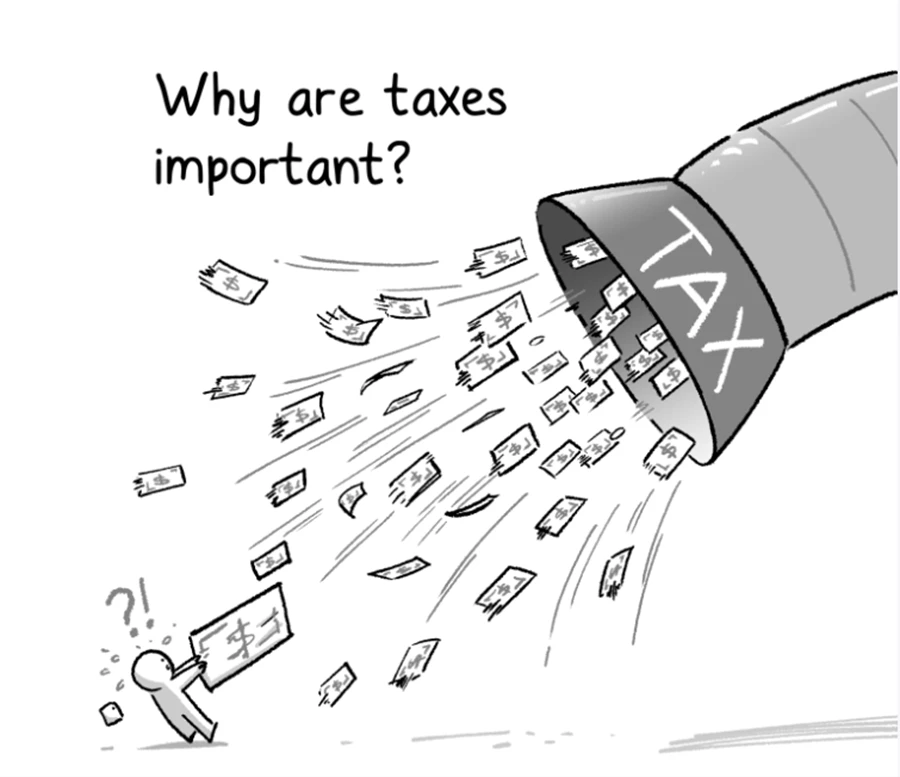
    A Singapore-based webcomic called The Woke Salaryman recently posted a comic extolling the virtues of taxation and encouraging people to pay their taxes. The comic, called “Why are taxes important?” goes through three common talking points about the supposed benefits of taxation and public services.

    Since these same points come up so frequently in debates over taxation, it’s worth taking the time to respond to them in turn. So let’s start with the first point and see what can be said in response.

    1) Public Services

    The first point the comic brings up in favor of taxation is the fact that taxes fund public services.

    “It may not always be immediately apparent, but we enjoy a lot of public services without a second thought of how they came to be,” it says. The comic goes on to list a variety of services the government provides, such as properly paved roads, healthcare facilities, parks to enjoy, and public education.

    Though these kinds of public services are often presented as an obvious boon to society, it’s worth asking why we should assume that. It’s not like this is a free lunch, after all. As Henry Hazlitt reminds us in Economics in One Lesson, we need to keep in mind the unseen costs of such services, namely, the things this money might have been spent on if it hadn’t been used to fund public services (economists call these forgone opportunities opportunity costs).

    The fact is that every dollar spent on public services is a dollar that can’t be spent on private services, so at best, this is just a one-for-one transfer. For every $1 million in public services we gain, we lose $1 million in private services.

    In reality, however, it’s almost always worse than that, because politicians—unlike private-sector entrepreneurs—have no way of knowing which allocation of resources will be the most beneficial to consumers.

    If consumers value hospitals much more than public parks, for example, entrepreneurs in a free market will be able to make a profit by taking land used for public parks and using it for hospitals instead. Over time, this will lead to less land being used for parks and more land being used for hospitals. Thus, resources will tend to be directed toward meeting the most urgent needs of the consumers.

    With public services, however, there is no way of knowing whether the service being provided is the best use of the resources being used, because there’s no profit and loss (this is known as the economic calculation problem). Thus, governments may maintain plenty of public parks out of an attempted benevolence, but they might actually be tying up land and other resources that could have been used for more important ends, like hospitals.

    However, since there are no losses to indicate this kind of waste is taking place, governments will tend to perpetuate these wasteful uses of resources, all the while patting themselves on the back for being so helpful to the community. In reality, public services are likely far less helpful than the services that would have been provided in the free market had consumers been allowed to keep their money and spend it on the things they valued most.

    Having listed examples of public services, the comic finishes the section with the following point. “Where does this money come from? That’s right; taxes. Put it simply, taxes are like your (mandatory) subscription fee to living in your country or community.”

    The problem with this point is that legitimate subscription fees are paid voluntarily by willing customers. But taxes are not voluntary. They are, in fact, a form of extortion. Now, some argue that taxes technically are voluntary because you can always leave the country if you don’t like them, but such claims are dubious to say the least.

    The 20th century economist Joseph Schumpeter put it well when he wrote that “the theory which construes taxes on the analogy of club dues or the purchase of a service of, say, a doctor only proves how far removed this part of the social sciences is from scientific habits of mind.”

    2) Encouraging and Discouraging Behavior

    The second argument the comic presents in favor of taxes is that they can be used to encourage and discourage certain types of behavior. When it comes to encouraging socially desirable behavior, the comic gives some examples such as tax relief for parents (encouraging people to start families) and tax deductions for donating money to charity (encouraging philanthropy).

    Socially undesirable behavior can likewise be discouraged with extra taxes, such as taxes on tobacco and alcohol to reduce the prevalence of smoking and drinking.

    One issue with this use of the tax system is that it amounts to a kind of paternalism. The state not only presumes to know what’s best for you, but is kind enough to give you various carrots and sticks to keep you on the right track—for your own good, of course.

    Not only does such a system foster resentment against the state—or at least it should—for trying to micromanage our lives, it also breeds social strife. When these kinds of policies are on the table, everything they touch is inevitably politicized. A variety of factions and tribes then form, each of them attempting to win control over the political system so they can 1) stop the other tribes from enacting their carrots and sticks and 2) force their own carrots and sticks on everyone else.

    Suffice it to say, this is hardly a recipe for social harmony.

    3) Helping the Poor

    The final argument the comic makes in favor of taxes is that they help support the more disadvantaged in society.

    “Most societies try to provide EVERYONE a decent shot at life; not just the wealthiest. For everyone to grow together, the government will collect money via various types of taxes, and use the resources to provide everyone with equal access to opportunity. This is done via grants, subsidies, or other forms of government support.”

    At the outset, it’s important to distinguish between two motivations for direct government transfers from the rich to the poor. The first is egalitarian—people believe the government should equalize the level of affluence in society, even if that means taking from some to give to others. The second is humanitarian—providing a social safety net for the poorest so they can afford to meet their basic needs.

    The egalitarian argument is often based on the idea of fairness. But why should income equality be considered fair? After all, many rich people worked very hard for their wealth, while many poor people have squandered resources even when they could have made better choices. Is it really fair to take from the former to give to the latter? And if so, how much is required to balance the scales? As the economist Thomas Sowell famously asked, “what is your ‘fair share’ of what someone else has worked for?”

    The humanitarian point is of course the better argument for using taxes to redistribute wealth from the rich to the poor. Very few will say we should simply let the poor starve so that rich people can have their yachts.

    But taxing the rich to fund social safety nets and letting the poor starve are not the only options here. The third option is for the government to simply get out of the way.

    Though the government likes to depict itself as the defender of the poor, the reality is that it often causes—or at least exacerbates—many of the economic problems the poorest among us face. Aside from mismanaging tax dollars as explained above, it also maintains a litany of regulations such as licensing requirements, zoning laws, IP laws, and tariffs that push the cost of living far higher than it needs to be.

    If these laws were repealed, economic prosperity would improve rapidly, and what little poverty remained after that could easily be addressed by charities and mutual-aid societies.

    Why not take the more direct root of wealth transfers through taxes? Because at the end of the day welfare systems still amount to robbing Peter to pay Paul. That doesn’t mean we should simply hang the Pauls of the world out to dry. But it does mean that solutions which don’t involve legal plunder should be favored wherever possible.

    The Path to Prosperity

    The comic closes by reiterating the benefits of taxation and exhorting people to contribute their fair share. “Want to live in a society that thrives?” it concludes. “Pay your taxes.”

    This message is hardly unexpected for a comic promoting taxation. But in light of the above analysis, a rather different takeaway seems to be in order.

    Far from being helpful, taxation is actually tremendously harmful, not just for taxpayers, but for almost everyone. It leads to wasted resources and political strife, and it unfairly takes from those who have earned their money through voluntary work and exchange.

    There are beneficiaries, of course, but they often look far more like politicians and special-interest groups than the poor and downtrodden we’re told we are helping. And even when taxes do genuinely help those who are disadvantaged, they are inevitably funding bureaucratic, mismanaged programs that are only needed because of barriers the politicians themselves erected.

    The path to a peaceful, prosperous, and harmonious society has nothing to do with taxation. That kind of society can only be achieved when people are allowed to keep their hard-earned money and spend it as they see fit.

    So, want to live in a society that thrives?

    Protest your taxes.

    Reprinted from Fee.org.  

    Image Credit: The Woke Salaryman